Weekly “What is it?”: Chocolate
I have always had a sweet tooth. While some folks prefer their
sweetness in fruit or fruity candy, my go-to has always been chocolate.
So, you can imagine my delight upon learning our national meeting for
Extension natural resource agents would be held in Hershey,
Pennsylvania. I just returned from the meeting last week, and got a
kick out of all the Hershey kiss-themed décor at our conference center,
hotel rooms, and throughout the city. Even the shampoo and soap had
cocoa in them!
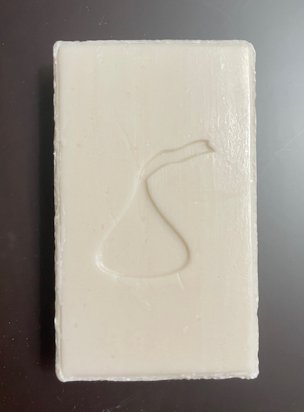
Hotel bath soap at the Hershey Lodge is made with (and smells like) cocoa
Chocolate
is a serious business, though—from its beginnings as a ceremonial drink
for the Mayans and Aztecs—to the multi-billion-dollar industry it is
now. Like many products, it literally takes contributions from the
whole world to make chocolate. I was rather fascinated to learn the
origins of the chocolate-making process while visiting the Hershey
Museum and Gardens.
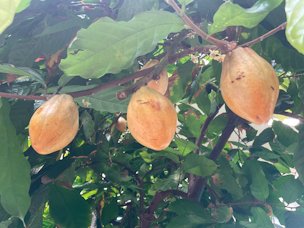
Cacao pods growing from a tree located in Hershey Gardens.
Chocolate starts with the cacao tree (
Theobroma cacao)
and its beans. While native to the Amazonian region of South America,
it can grow in nearly any equatorial region and is now predominantly
farmed in West Africa. Cacao farms consist of leafy green trees, so
they look more like rainforests than the open fields we are accustomed
to in agriculture.
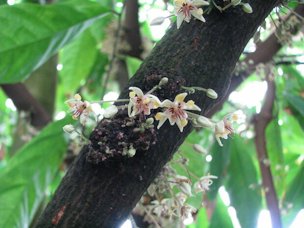
Cacao blossoms exhibiting “cauliflory” as they grow directly from the trunk. Taken at the New York Botanical Garden.
interestingly,
the cacao tree grows its flowers directly on the main trunk, exhibiting
“cauliflory” just like the Eastern redbuds I highlighted a few weeks
ago. The tree’s fruit, called pods, are the size and shape of smallish
footballs. Inside are the cocoa beans, covered in a gelatinous white
pulp that is also edible. The pulp has been described as having a
“tropical” flavor reminiscent of mango, lychee, or peach, and is used
in some places for jams, ice creams, and juices.
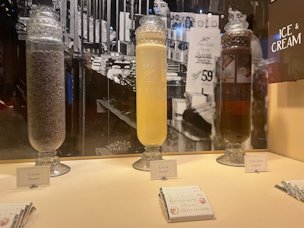
The beginning stages of chocolate making–from bean to cocoa butter and chocolate liquor.
Most
of us are more familiar with the cocoa beans. Hershey, the 5th largest
producer of chocolate in the world, started out using nearly every part
of the cacao pod. After the seeds were removed, dried, and crushed for
the chocolate-making process, they were separated out into “chocolate
liquor” and cocoa butter.
The liquor is used in the actual
chocolate-making process, and cocoa butter has been used over the years
for products like soap, lotion, and shampoo. Early in the Hershey
company’s history, they crushed the pods into mulch and sold it to
gardeners.
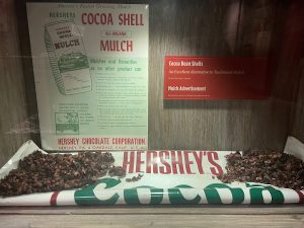
Early in the history of Hershey’s chocolate, discarded cacao pods were crushed into mulch and sold to gardeners.
Each
tree grows about 30 pods per year. According to the Hershey Museum’s
“Chocolate Math” curriculum, each of those pods contains 30-50 beans.
To make a pound of chocolate, you need 500 beans—so one average cacao
tree will yield approximately 2 pounds of chocolate. With worldwide
chocolate consumption hovering around 16 billion pounds, that’s a LOT
of trees.
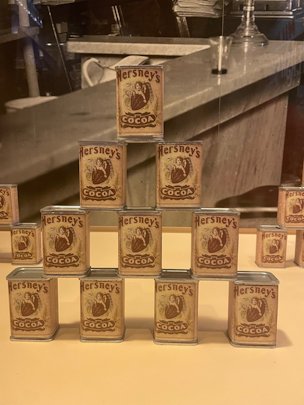
Early Hershey’s logos prominently featured a cacao pod.
There
have been headlines lately about chocolate prices going up. This is due
to several factors, but in large part to climate change. While the
trees already grow in hot regions, the increase in temperature is also
increasing evapotranspiration rates, drying them out faster. Drought
conditions are devastating to these trees. Farmers are trying to adapt
by growing the trees in the shade of larger trees or moving production
up-slope to slightly cooler mountainsides. This, of course, requires
clearing and planting in previously undisturbed rainforest, which can
have a huge impact on wildlife and other ecosystem functions.
Researchers are also working on newer varieties of cacao trees that
will be able to survive the changing climatic conditions.
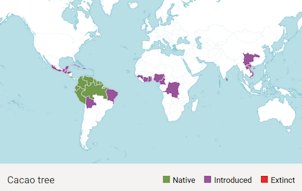
|
| Map of worldwide cacao tree distribution. Diagram courtesy Kew Gardens. |
Back toCacao Page