| Papaya - Carica papaya | |||||||||||||||||||||||||||||||||||||||||||||||
|---|---|---|---|---|---|---|---|---|---|---|---|---|---|---|---|---|---|---|---|---|---|---|---|---|---|---|---|---|---|---|---|---|---|---|---|---|---|---|---|---|---|---|---|---|---|---|---|
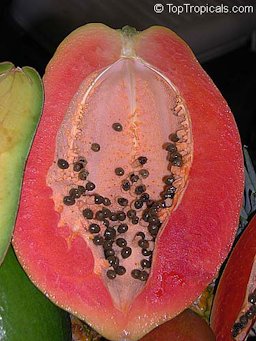 Fig. 1 Carica papaya 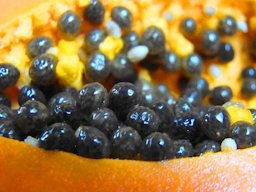 Fig. 2 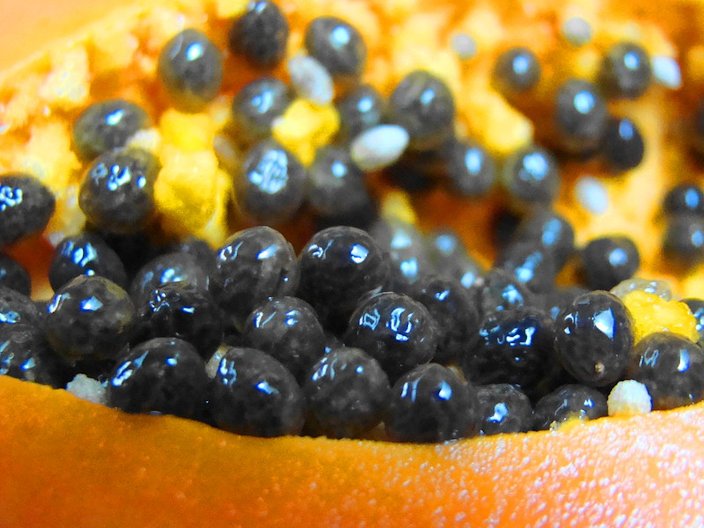 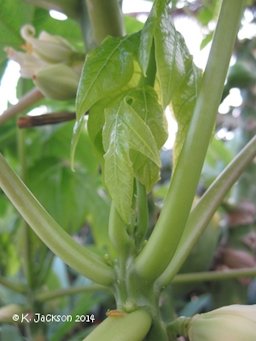 Fig. 3 Point of growth 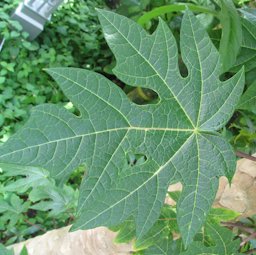 Fig. 4 C. papaya, 'Tropical Dwarf' papaya 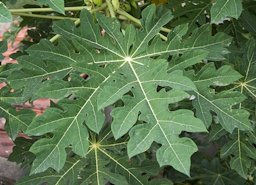 Fig. 5 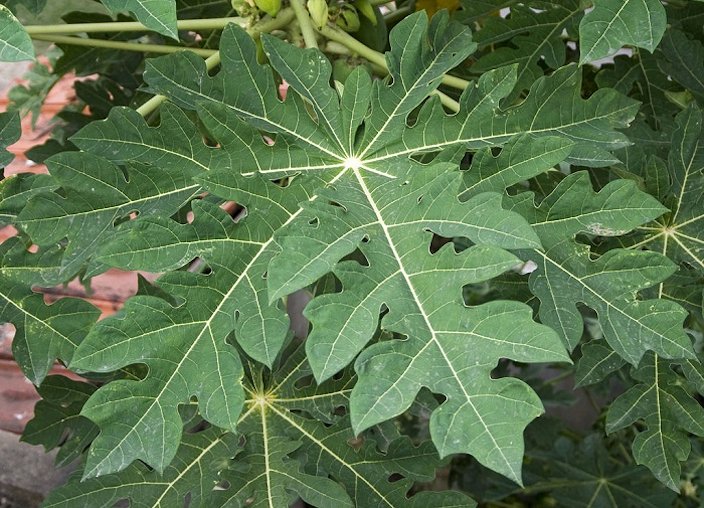 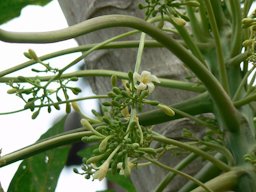 Fig. 6 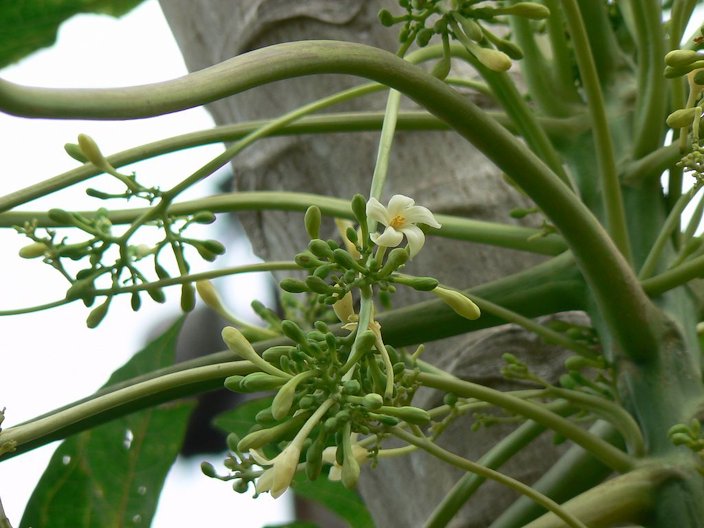 C. papaya, male flowers, Thane, India 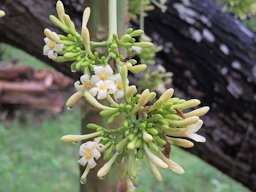 Fig. 7 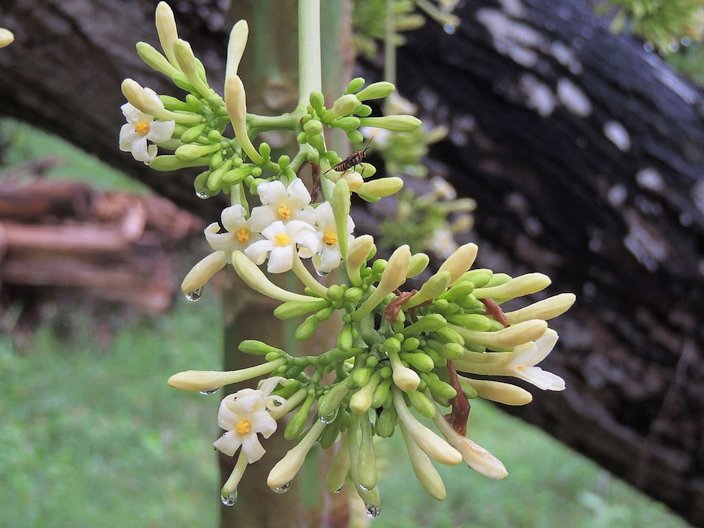 C. papaya, flowers on male plant 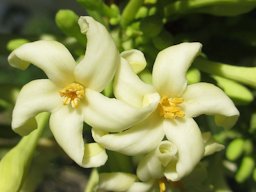 Fig. 8 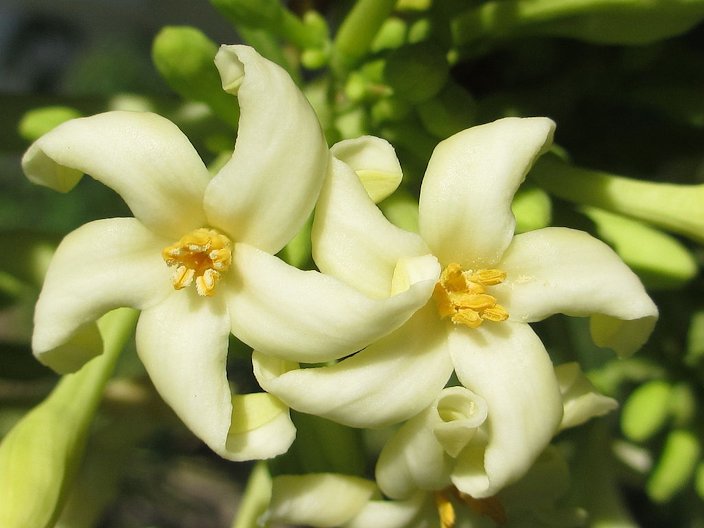 C. papaya male flowers in Mozambique, Africa 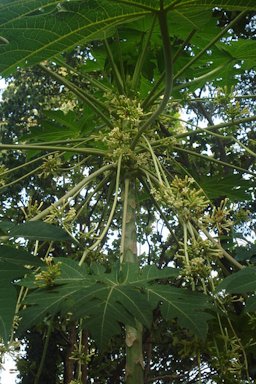 Fig. 9 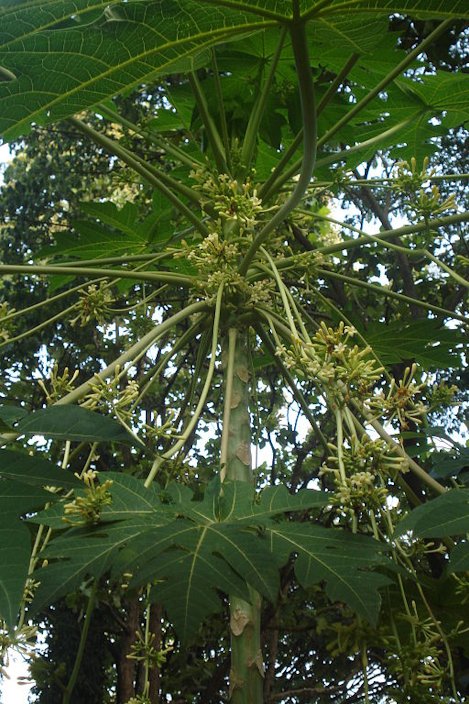 Male plant of papaya; flowers do not produce fruit 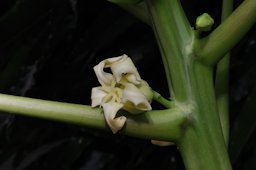 Fig. 10 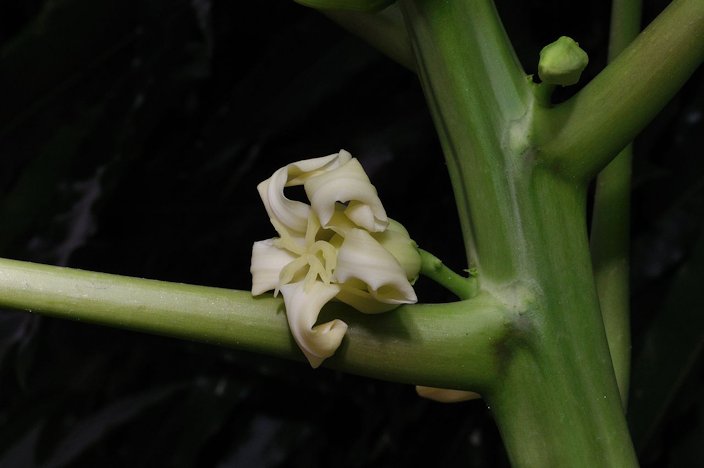 Papaya flower in small papaya tree about 7 ft high in Kolkata, India 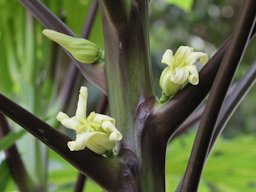 Fig. 11 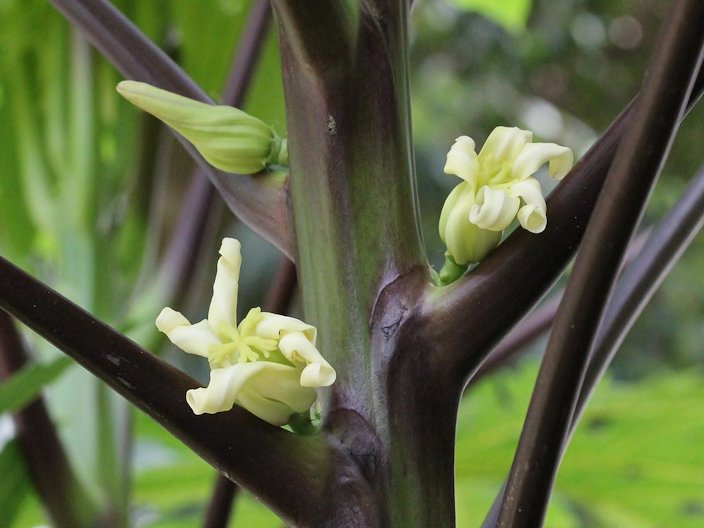 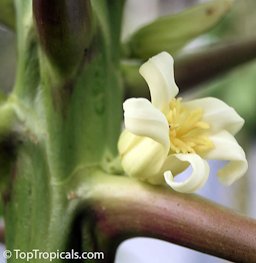 Fig. 12 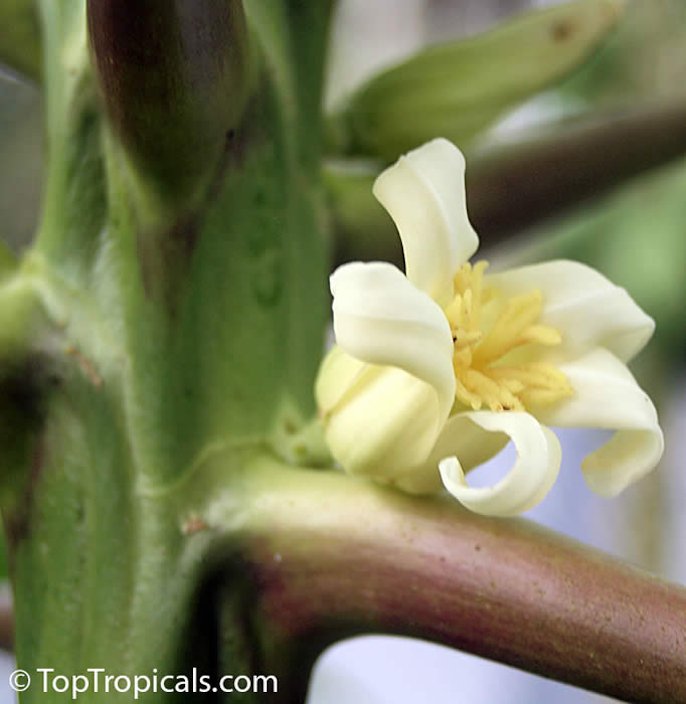 Female flower 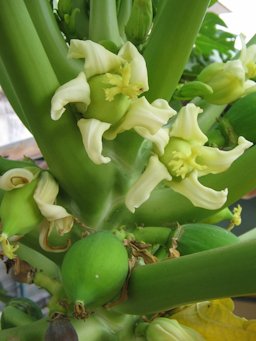 Fig. 15 Fig. 15 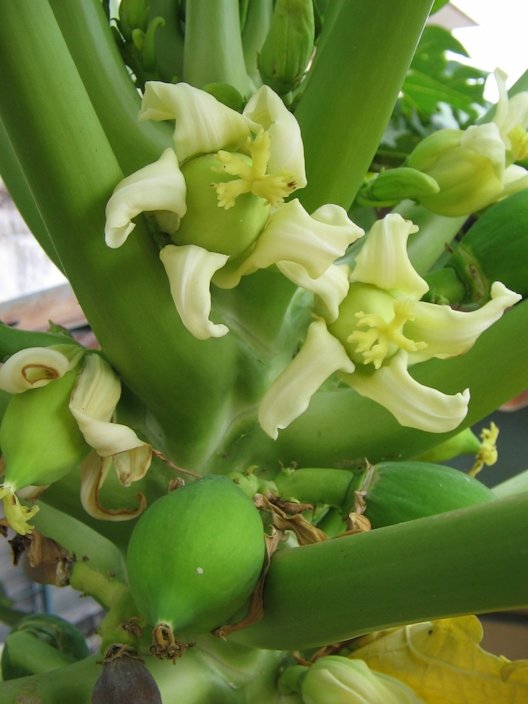 Close-up of female flowers and immature fruits 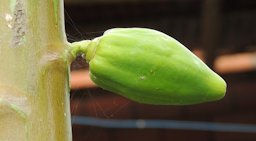 Fig. 16 Young fruit 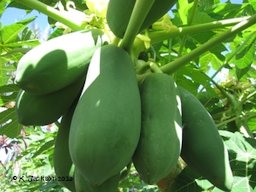 Fig. 17 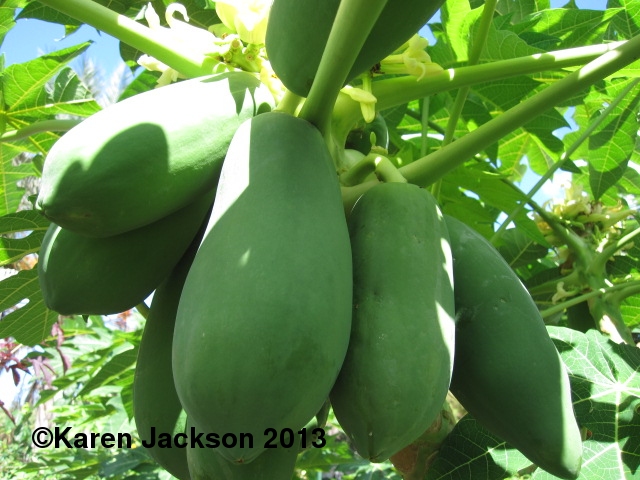  Fig. 18 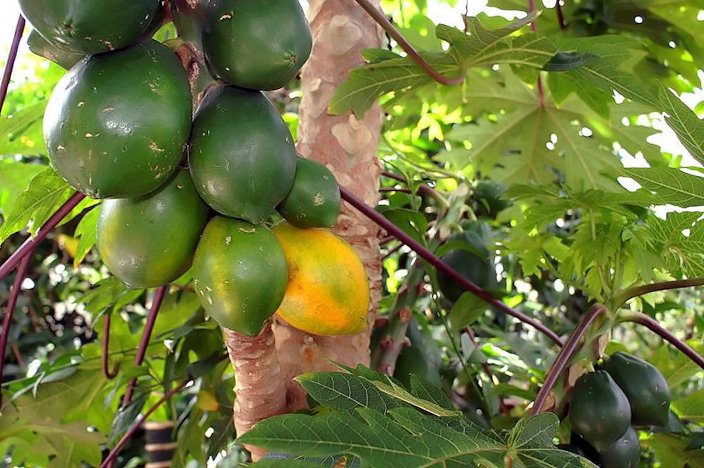  Fig. 19 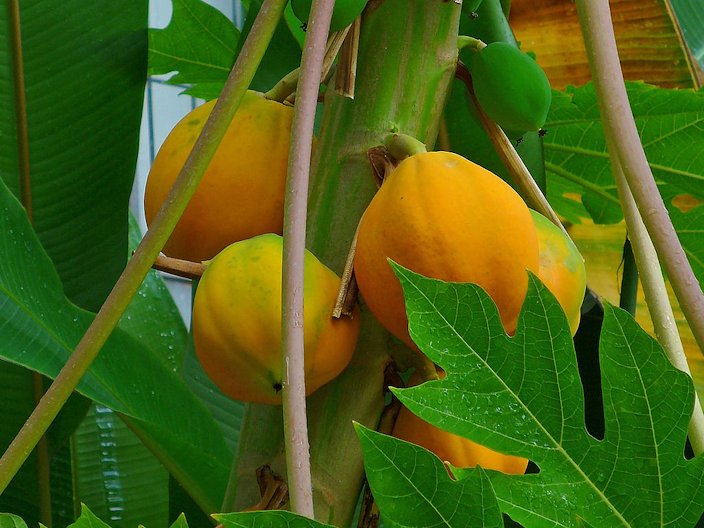 C. papaya, Caricaceae, papaya fruits; Botanical Garden KIT, Karlsruhe, Germany. The leaves are used in homeopathy as remedy. 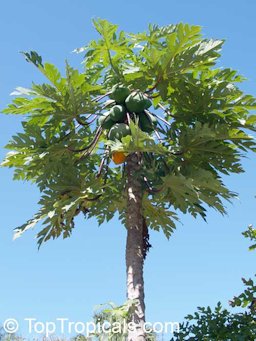 Fig. 27 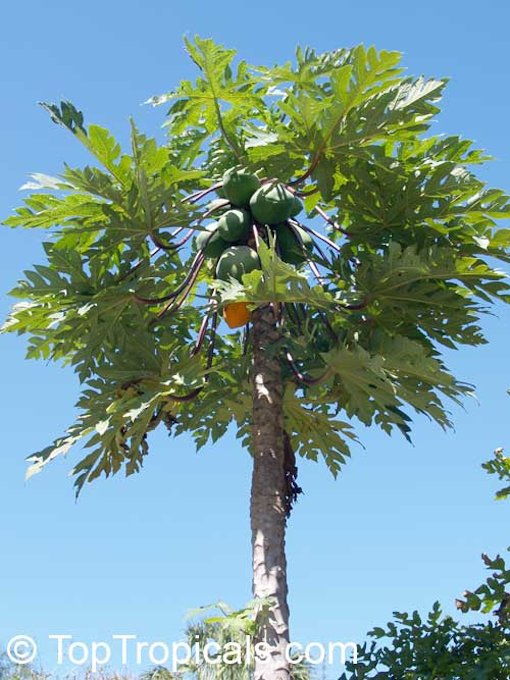 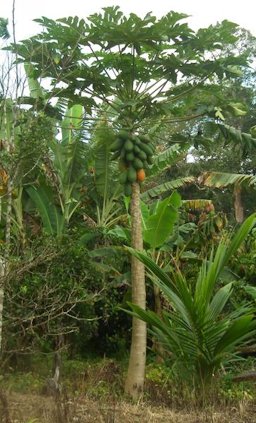 Fig. 28 Growing in a woodland garden, Brazil 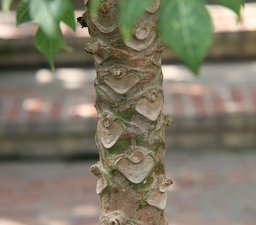 Fig. 29 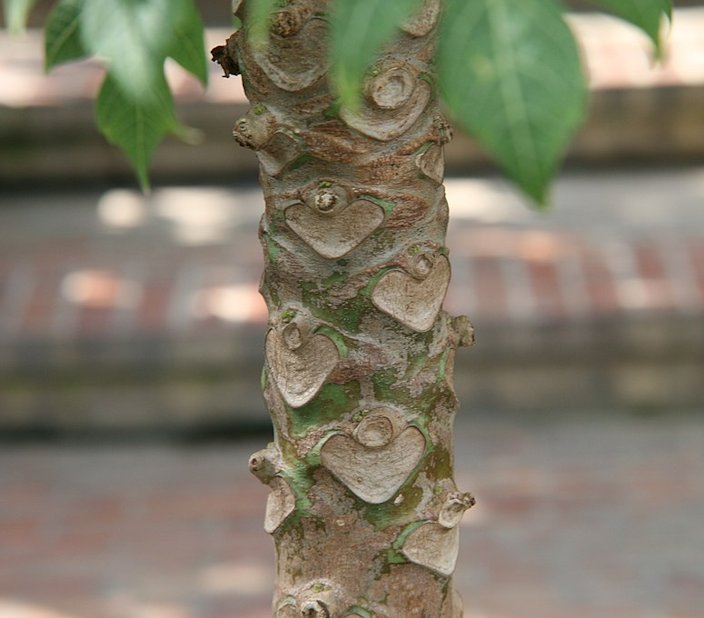 C. papaya L., Longwood Gardens, Kennett Square, Pennsylvania  Fig. 30 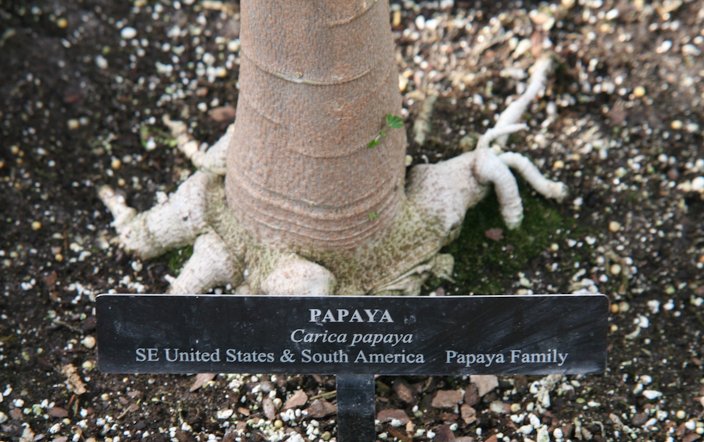 Longwood Gardens, Kennett Square, Pennsylvania 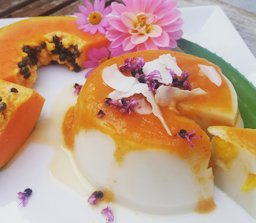 Fig. 31 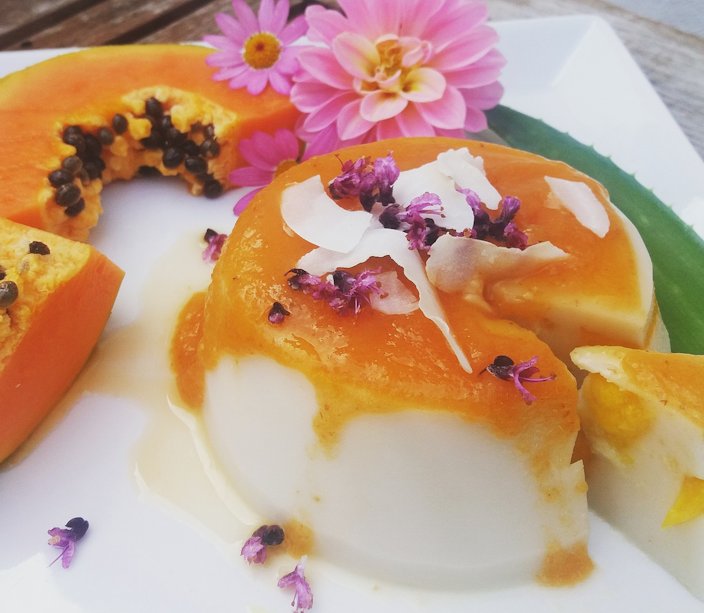  Fig. 32 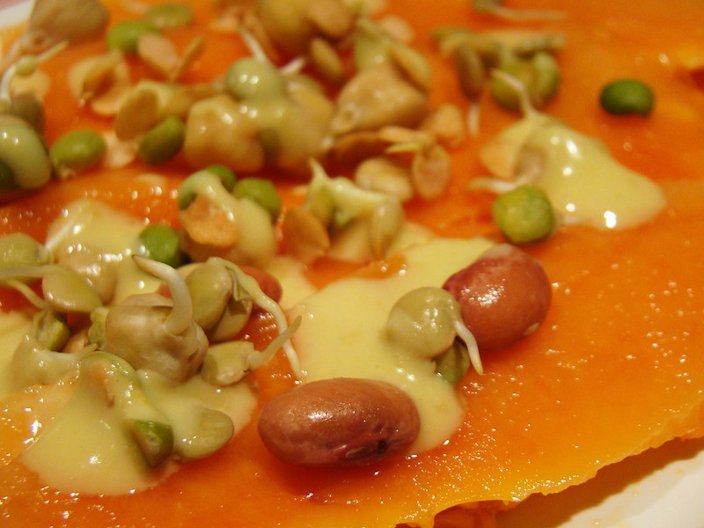 Lemoned papaya carpaccio with sprouts 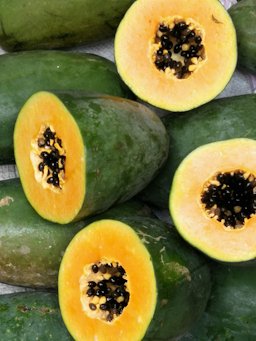 Fig. 38 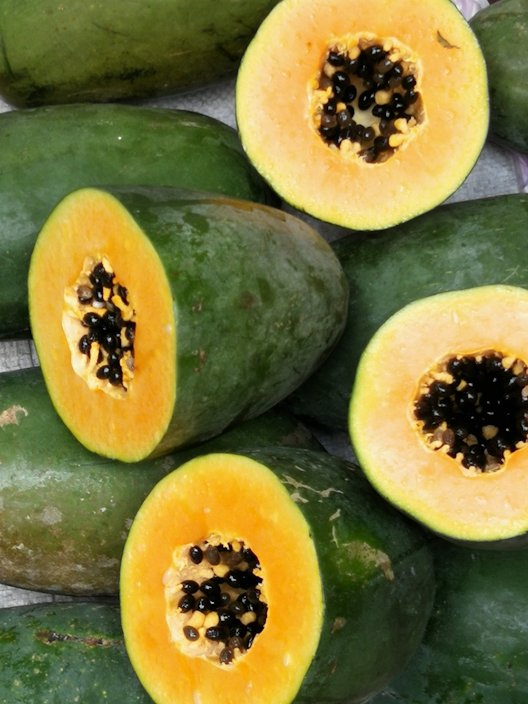 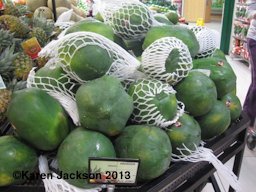 Fig. 39 Papayas, Dubai market  Fig. 40 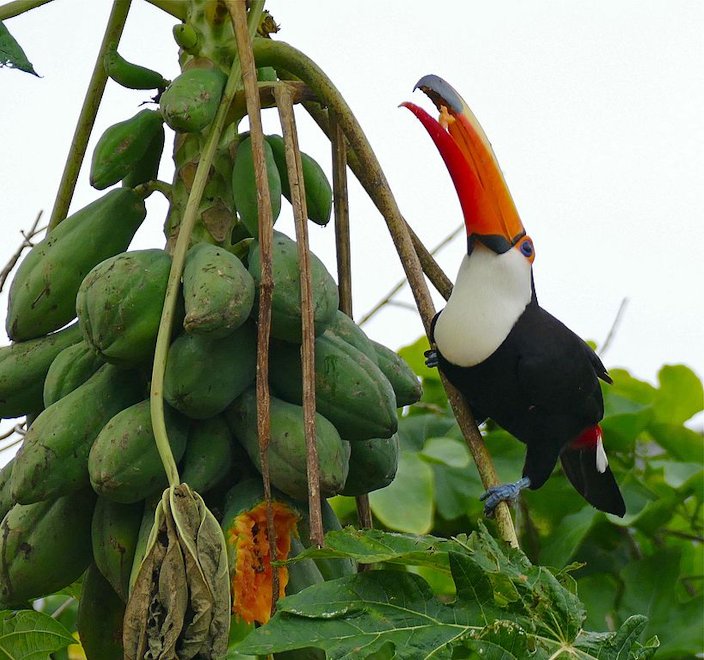 Toco toucan (Ramphastos toco) eating papaya (C. papaya), Poconé, Mato Grosso, Brazil  Fig. 41 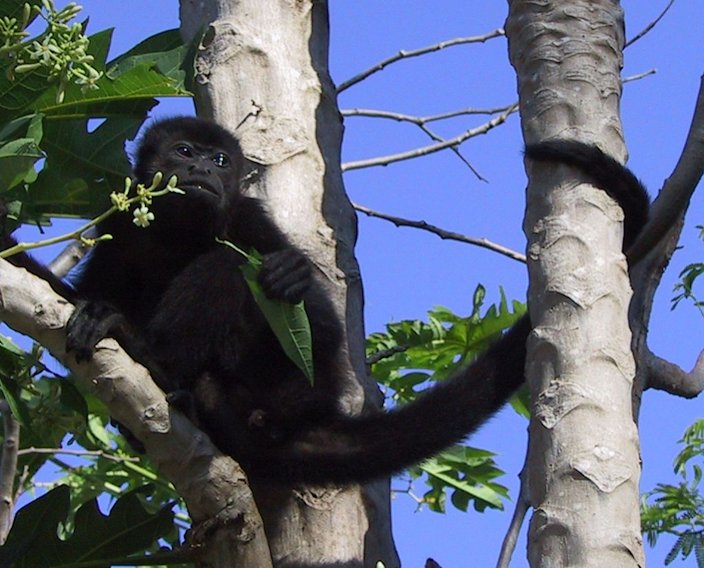 Alouatta pigra (Howler monkey), eating leaves of C. papaya (Costa Rica, peninsula Nicoya, Cabo-Blanco) |
Scientific
name Carica papaya L. Pronunciation kAIR-rick-uh puh-PYE-yuh 6 Common names English: papaya, pawpaw, tree melon; Dutch: boommeloen, meloenboom, papaja, papajaboom; French: papaye, papayer; German: Melonenbaum, Papajabaum, Papajapflanze; Italian: papaia; Portuguese (Brazil): mamão, papaia; Spanish: fruta bomb, lechosa, mamón, melón de árbol, papaya, papayo; Swedish: papaja; Thai: malakor, loko, ma kuai thet; Vietnamese: du du 7 Synonyms Relatives Babaco, C. pentagona; mountain papaya, C. pubescens; chamburo, C. stipulata 9 Family Caricaceae (papaya family) Origin Native to tropical and subtropical America; native member of the Florida flora 12,14 USDA hardiness zones 9b-11a 2 Uses Food; specimen; border; accent 2 Height 10-15 ft (3-4.5 m) 2 Spread 5-7 ft (1.5-2.1 m) 2 Plant habit Woody large perennial herb with stout hollow trunk Growth rate Rapid Longevity Generally short-lived, although may live up to 20 years Trunk/bark/branches Stem semi-woody, hollow; site of starch storage; bark smooth, greyish; large, prominent leaf scars 8 Leaves Deeply lobed, palmate; 10-24 in. (25.4-61 cm); short-lived, 6-8 months; grow from the top part of the stem in a spiral Flowers Polygamous, with three primary sex types: female, male and bisexual; white; fragrant; flowers all year Fruit Fleshy berry; 3-18 in. (7-35 cm); size and shape varies; 0.5-22 pds (0.250–10 kg); flesh yellow to orange-red; numerous peppery black seeds; fruit is from female and bisexual plants 1 Season Fruits all year; best during July-Oct. USDA Nutrient Content pdf Light requirement Full sun; when subjected to shade the plant grows tall with increased internode length and etiolated leaves 5 Soil tolerances Tolerate any kind of soil provided it is well-drained and not too dry 10 pH preference 4.5-8.0 1 Drought tolerance Lack of water (drought) will reduce growth and production 1 Aerosol salt tolerance Poor Soil salt tolerance Moderately salt sensitive 8 Wind tolerance Susceptible to wind damage and will not establish or grow well in continuously windy areas Cold tolerance Not tolerant of freezing temperatures; damaged or killed below 31 °F (-0.6 °C) Flood tolerance Roots are very sensitive to waterlogging; even short periods of flooding can kill the plants 10 Plant spacing 7-12 ft (2.1-3.7 m) 1 Roots Extensive root system; usually not a problem 2 Invasive potential * Not evaluated Pest resistance Papaya plants are attacked by a number of insect pests; should be mulched to alliviate nematode problems Known hazards Can cause skin irritation because of the action of fresh papaya latex; possible hazard of consuming undercooked meat tenderized with papain; the pollen has induced severe respiratory reactions in sensitive individuals 4 Reading Material Papaya Growing in the Florida Home Landscape, University of Florida pdf Papaya, Fruits of Warm Climates Papaya, California Rare Fruit Growers Carica papaya L., PROSEA Foundation Carica papaya: Papaya, University of Florida pdf Origin Papaya origins are rather uncertain, but there is some agreement among botanists that it originated in the lowlands of Central America, between southern Mexico and Nicaragua. Early distribution over a wide geographical region in Central and South America was aided by the abundance of seeds in the fruit and the seeds long viability. 8 For some years a series of excavations has been underway on Pine Island, just inland from Sanibel Island, Lee County, Florida. The Pineland Site Complex is acknowledged as a remarkable deposit of early settlement and is listed in the National Register of Historic Places. Only 8 seeds of Carica were found among the many recovered seeds. They were indubitably Papaya. There can now be no question that this species was introduced to Florida by the early inhabitants, probably the Calusa, no later than 300 A.D., vastly predating European influence. The Papaya (Carica papaya) is thus confirmed to be a native member of the Florida flora. 12 Origin of the Papaya, Tropical Fruit News, RFCI Description Papaya (Carica papaya L.) is a popular fruit native to tropical America. It is usually grown for its small to large melon-like fruit. It is a herbaceous perennial, bearing fruit continuously at the leaf axils spirally arranged along the single erect trunk. The cultivated papaya belongs to the family Caricaceae and is the only member of the genus Carica. 8 Enormous, simple, lobed leaves combine with a single trunk and delicious fruit to make this a desirable plant for many landscapes. Flowers are produced along the trunk from the leaf axil. Flowers on male plants are more conspicuous and showy; female flowers are borne close to the stem and usually go unnoticed. Fruit are produced in the leaf axil close to the trunk. The trunk becomes thickened, occasionally growing to 12 in. (30 cm) in diameter. Although older plants can reach 20 ft (6 m) tall or more, most reach only 15 ft (4.5 m) before dying. Plants are short lived but grow quickly. 2 Leaves Leaves are palmately-lobed and short-lived, 6–8 months. 1 The leaves emerge directly from the upper part of the stem in a spiral on nearly horizontal petioles 1-3.5 ft (30-107 cm) long. The blade, deeply divided into 5 to 9 main segments, varies from 1-2 ft ((30-61 cm) in width, and has prominent yellowish ribs and veins. 9 Flowers There are three primary groups of flowers, i.e. pistillate, staminate and hermaphrodite, with many variants, especially in the hermaphrodite group. 8 The 5-petalled flowers are fleshy, waxy and slightly fragrant. Some plants bear only short-stalked pistillate (female) flowers, waxy and ivory-white; or hermaprodite (perfect) flowers (having female and male organs), ivory-white with bright-yellow anthers and borne on short stalks; while others may bear only staminate (male) flowers, clustered on panicles to 5 or 6 ft (1.5-1.8 m) long. There may even be monoecious plants having both male and female flowers. 4
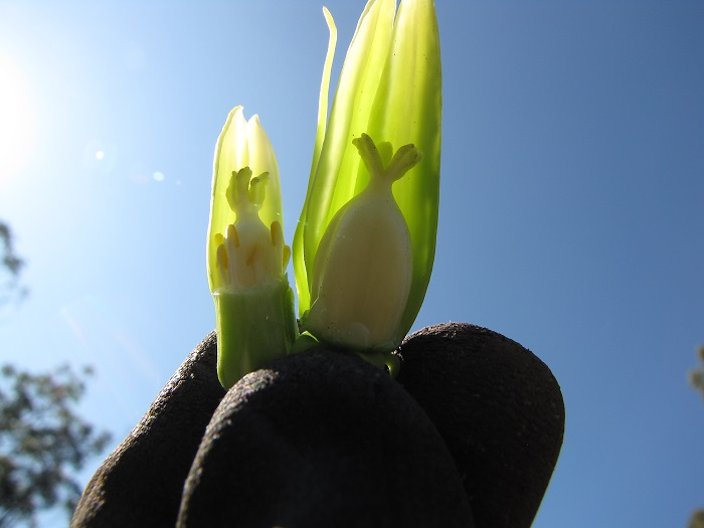
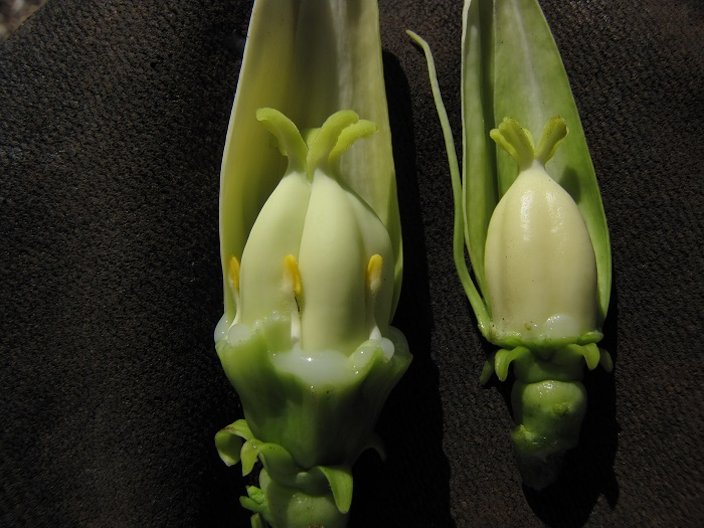
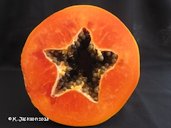
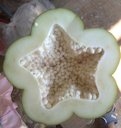
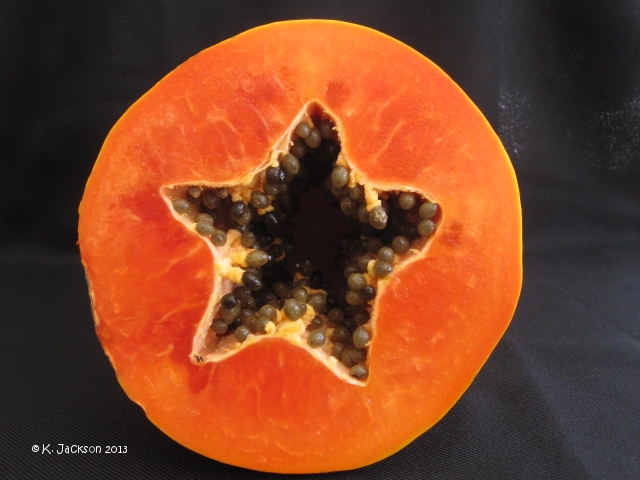
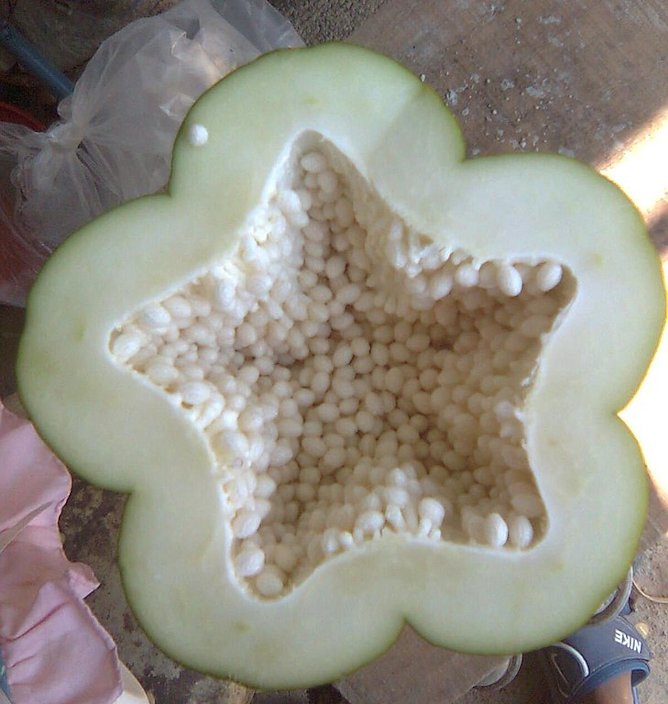
Fig. 13,14. Hermaphrodite flower on left, female on right Pollination Papaya is a polygamous species with 3 basic plant types. Male (staminate) plants, in which small, tubular, yellow flowers possessing 10 anthers are held in cymes at the ends of long peduncles (Fig. 7). Female (pistillate) plants with large yellow to whitish flowers which possess a large, superior ovary which is held on a much-reduced cyme in the leaf axils along the trunk (Fig. 17). Bisexual (hermaphroditic) plants possess perfect flowers held on a much-reduced cyme in the leaf axils along the trunk. 1 Papaya plants may be self-pollinating (bisexual plants) or cross pollinated by insects and wind. Pollinators include honey bees, wasps, midges, thrips, surphid flies, and butterflies. 1 Unpollinated female plants occasionally set parthenocarpic fruits, lacking seeds. Hermaphrodite plants tend to produce self-pollinated seeds, which result in relatively uniform progenies. 11 Fruit There are two types of papayas, Hawai'ian and Mexican. The Hawai'ian varieties are the papayas commonly found in supermarkets. These pear-shaped fruit generally weigh about 1 pd (0.5 kg) and have yellow skin when ripe. The flesh is bright orange or pinkish, depending on variety, with small black seeds clustered in the center. Hawai'ian papayas are easier to harvest because the plants seldom grow taller than 8 ft (2.5 m). Mexican papayas are much larger the the Hawai'ian types and may weigh up to 10 pds (4.5 kg) and be more than 15 in. (38 cm) long. The flesh may be yellow, orange or pink. 9 Generally, the fruit is melon-like, oval to nearly round, or elongated, 6-20 in. (15-50 cm) long and 4-8 in. (10-20 cm) thick; weighing over 10 kg (22 pds). The skin is waxy and thin but fairly tough. When the fruit is green and hard it is rich in white latex. As it ripens, it becomes light or deep-yellow externally and the thick wall of succulent flesh becomes aromatic, yellow, orange or various shades of salmon or red. It is then juicy, sweetish and somewhat like a cantaloupe in flavour; in some types quite musky. Attached lightly to the wall by soft, white, fibrous tissue, are usually numerous small, black, peppery seeds about 0.2 in. (5 mm) long, each coated with a transparent, gelatinous aril. 5 The shape of the cavity at the transverse cut ranges from star-shape with 5-7 furrows, to smooth and circular in shape. 8 Female plants produce medium to large round-shaped fruit of good quality and a large seed cavity. Bisexual plants produce small to large elongated fruit of good quality and a smaller seed cavity. Male plants with bisexual flowers may produce a few, elongated, pear-shaped, poor quality fruit. 1 The papaya fruit skin has a network of lactifers which, in immature fruits contains an abundance of milky, proteolytic latex called papain. The papain is under pressure and spurts out when the skin is pricked. The lactifers collapse as the fruit ripens and there is little or no latex at the fully ripe stage. 5
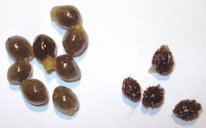
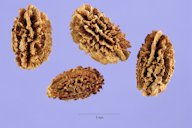
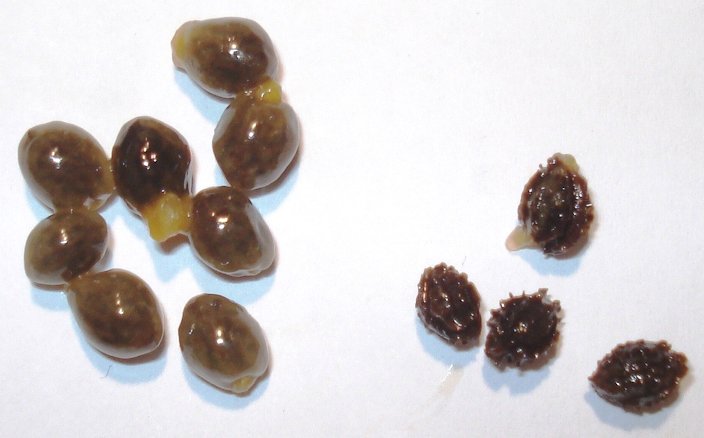
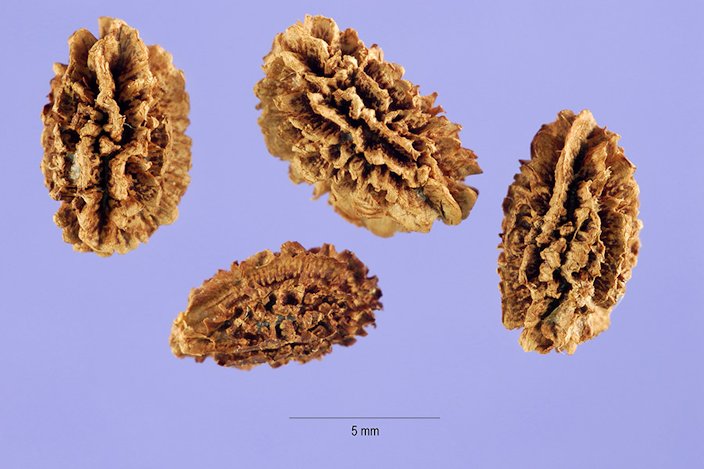
Fig. 20. 'Hawai'i's papaya' Fig. 21. Transversal cut of immature papaya Fig. 22. Seeds with sarcotesta intact and removed Fig. 23. Seeds dried
Varieties There are numerous varieties of papaya. However, very few are available to most urban residents because of the seeds are not commonly for sale in small amounts. Important varieties in the U.S. include 'Red Lady', 'Maradol', 'Tainung No. 1' and various Solo-types. 1 Papaya Collection, USDA Agricultural Research Service
Harvesting Well-cared-for plants may begin to produce flowers 4 months after planting and fruit 7 to 11 months after planting. The amount of fruit produced by a papaya plant varies with the general climate, weather conditions during the year, and plant care. Yields vary from 60-80 pds (27-36 kg) per tree over a 12 month period. 1 Home gardeners should take steps to avoid having only a single papaya plant, in case it turns out to be a female. One way to accomplish this is have several plants in the garden, to ensure the possibility that at least one will be a hermaphrodite with pollen. 3 Papaya Maturity Chart, University of Hawai'i at Mānoa Extension pdf Why Some Papaya Plants Fail to Fruit, University of Hawai'i at Mānoa Extension pdf Propagation Seeds retain their viability for 2-3 years when kept air-dry in airtight containers. 13 Papaya is mainly propagated by seed. The sarcotesta enveloping the seed is removed (because it inhibits germination) by rubbing the seed together against a fine-meshed screen under running water. Thoroughly dried seeds stored in air-tight containers remain viable for several years. The sex of the plant is determined by its parents. 1,10 Papaya plants can also be grown from cuttings, which should be hardened off for a few days and then propped up with the tip touching moist, fertile soil until roots form. Semihardwood cuttings planted during the summer root rapidly and should fruit the following year. 9 How to Grow Papaya from Seed, Hoffman Family Foundation Opening the Door on the Mysterious Sexual Antics of Pawpaws, Rare Fruit Club WA Sexing Pawpaws, Rare Fruit Club WA Grafting Pawpaws, Rare Fruit Club WA Propagation of Papaya (Carica papaya L.) with Large-sized Cuttings, Florida State Horticulture Society pdf
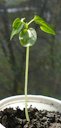
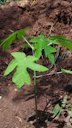
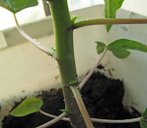
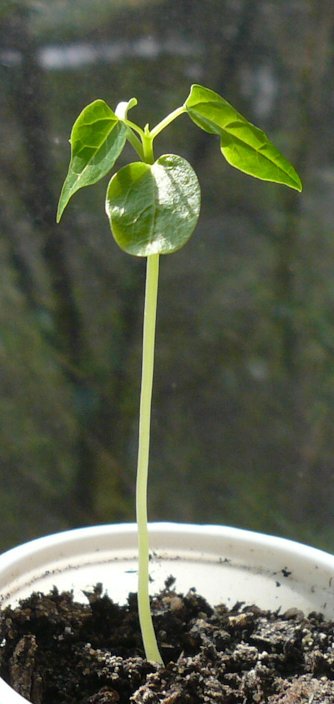
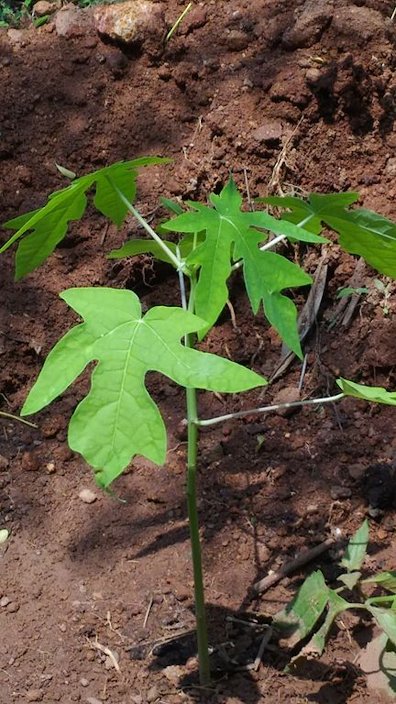
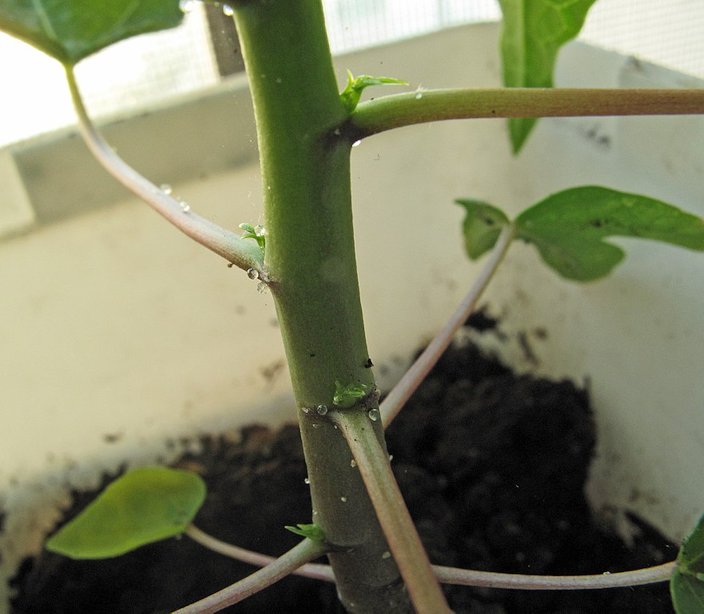
Fig. 24. Papaya seedling Fig. 25. A seedling of 'Red Lady' Fig. 26. Healthy seedling of Mexican papaya (C. papaya) has about 8 true leaves; there are tiny balls of sap on the main stem and leaf stems Planting Papaya plants should be planted in full sun and at least 10 to 20 ft (3.1-6.1 m) away from other plants, buildings, and power lines. In general, planting 2 to 3 papaya plants 7 to 12 ft (2.1-3.7 m) away from each other will insure that at least one will be fruitful, and it will also facilitate fertilizing and watering. 1 Overcrowded fruits should be thinned out when young to provide room for good form development and avoid pressure injury. After the first crop, the terminal growth may be nipped off to induce branching which tends to dwarf the plant and facilitates harvesting. Select the warmest area of the landscape that does not flood (or remain wet) after typical summer rainfall.
How to Protect your Papaya Fruit from the Papaya Fruit Fly, Garden Web Forum Pruning Papaya plants are not pruned because their main growing point is terminal, and branched trees generally do not produce as well. If the main growing point is damaged or killed, side sprouts may grow. Selecting 1 or 2 of the most vigorous shoots and removing the others will facilitate growth and fruiting of the remaining shoots. Tying these side shoots to a stake will reduce the chance they may break off due to a heavy fruit load or high winds. 1
Fertilizing
Fertilizer Recommendations, University of Florida Boron Deficiency in Papaya, University of Hawai'i at Mānoa pdf Irrigation Watering is essential for best papaya plant growth and fruit production. Papaya plants that lack water (drought stress) may drop flowers, leaves, and young fruit and produce small fruit of low sugar content. 1
Diseases Page Pests Page Injuries and Other Symptoms Food Uses Ripe papayas are most commonly eaten fresh, merely peeled, seeded, cut in wedges and served with a half or quarter of lime or lemon. Sometimes a few seeds are left attached for those who enjoy their peppery flavor but not many should be eaten. 4 Papayas are also processed into various forms, such as dehydrated slices, chunks and slices for tropical fruit salads and cocktails, or processed into puree for juices and nectar base, usually frozen, and as canned nectar, mixed drinks and jams. Papaya puree is the basis for remanufacturing of many products. 8 Papaya is a prime source of papain enzyme (meat tenderizer), so green fruit chunks and leaves can be wrapped around meat or fowl before cooking to enhance tenderness and flavor. 15
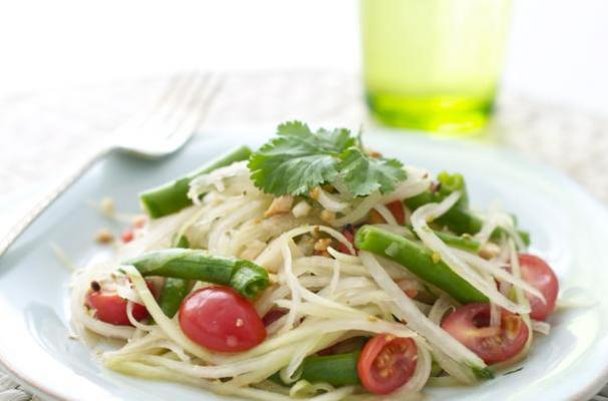
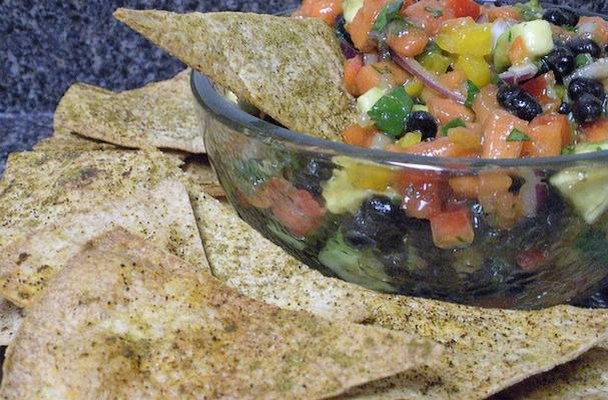
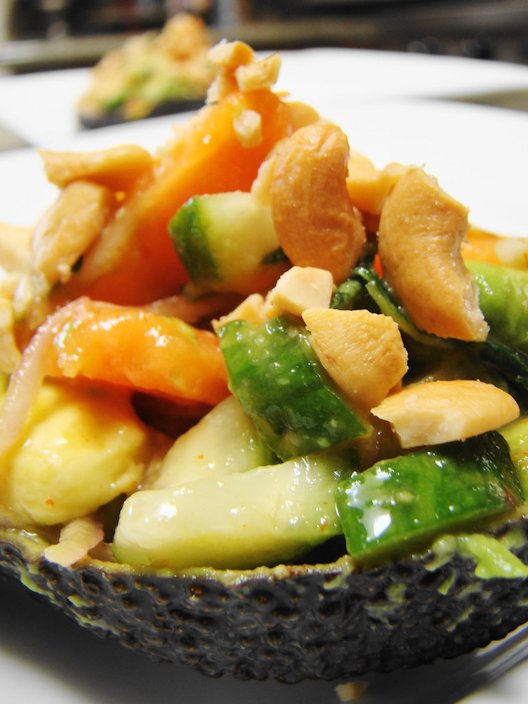
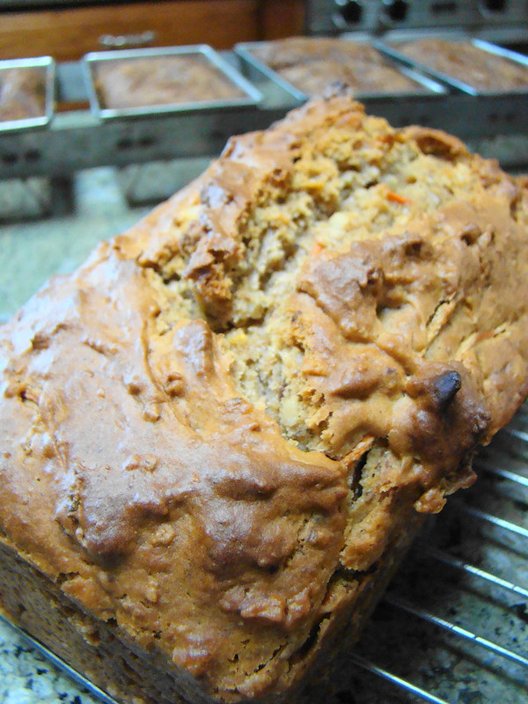
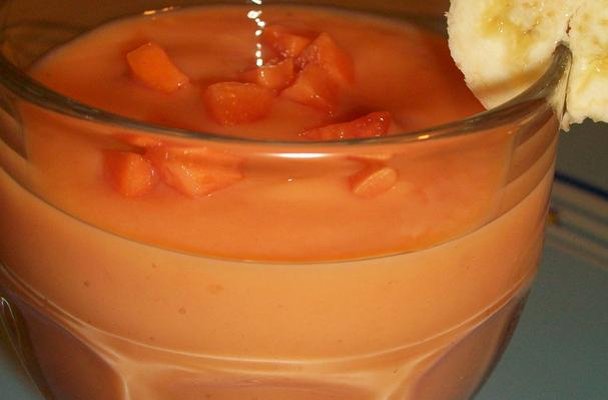
Fig. 33. Refreshing Thai green papaya salad Fig. 34. Papaya black bean salsa Fig. 35. Avocado papaya salad Fig. 36. Papaya bread Fig. 37. Papaya banana smoothie Papaya, Taste Florida's Tropics Nutrient Content About 60% of the ripe fruit is edible. The approximate contents per 100 g edible portion are: water 86.6 g, protein 0.5 g, fat 0.3 g, carbohydrates 12.1 g, fibre 0.7 g, ash 0.5 g, potassium 204 mg, calcium 34 mg, phosphorus 11 mg, iron 1 mg, sodium 3 mg, vitamin A 450 mg, vitamin C 74 mg, thiamine 0.03 mg, niacin 0.5 mg, and riboflavin 0.04 mg. The energy value is 200 kJ/100 g. Major sugars are sucrose (48.3%), glucose (29.8%) and fructose (21.9%). 10 Toxicity Externally the latex is irritant, dermatogenic, and vescicant. Internally it causes severe gastritis. Some people are allergic to the pollen, the fruit, and the latex. Papain can induce asthma and rhinitis. The acrid fresh latex can cause severe conjunctivitis and vesication. 13 According to Morton (1977) the latex will digest tissue and cause sores under rings and bracelets, while it has been used internally for malicious poisoning. Mitchell and Rook (1979) report a yellowing of the palms and soles caused by eating papaya. Anaphylaxis is reported in about 1% of cases of chymopapain injections. 13 Medicinal Properties ** Studies at the University of Nigeria have revealed that extracts of ripe and unripe papaya fruits and of the seeds are active against gram-positive bacteria. Strong doses are effective against gram-negative bacteria. The substance has protein-like properties. The fresh crushed seeds yield the aglycone of glucotropaeolin benzyl isothiocyanate (BITC) which is bacteriostatic, bactericidal and fungicidal. A single effective does is 4-5 g seeds (25-30 mg BITC). 4 Papaya the Medicine Tree, Archives of the Rare Fruit Council of Australia Papain The latex of the papaya plant and its green fruits contains two proteolytic enzymes, papain and chymopapain. The latter is most abundant but papain is twice as potent. 4 Papain is a proteolytic enzyme that digests proteins and is used as a meat tenderizer, as a digestive medicine in the pharmaceutical industry, in beer brewing, tanning industries and in the manufacture of chewing gum. 8 Commercially, the skin is scarified to induce latex flow, which is allowed to dry then collected to be later processed into papain. 8 Nearly 80% of American beer is treated with papain, which digests the precipitable protein fragments and then the beer remains clear on cooling. 13 United States is the principal importer of papain, using it mainly for meat tenderizers, beer treatment, chewing gum, and textile and tanning industry. United States imports about 340 tons of crude papain. 13 General Caricaceae is a small family of dicotyledonous plants with six genera; four of tropical American origin (Carica, Jarilla, Jacaratia, Vasconcella) and one, Cylicomorpha, from equatorial Africa. Caricaceae species have been variously classified in families such as Cucurbitaceae, Passifloraceae, Bixaceae and Papayaceae. Approximately 71 species have been described, though Badillo (1993, 2000) reduced the number to 32 species, with the following distribution: Carica, 1 species, Cylicomorpha, 2 species, Jacaratia, 5 species, Jarilla, 3 species, Vasconcella, 20 species, and Horovitzia, 1 species. 8
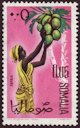
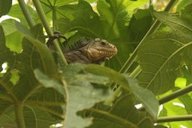
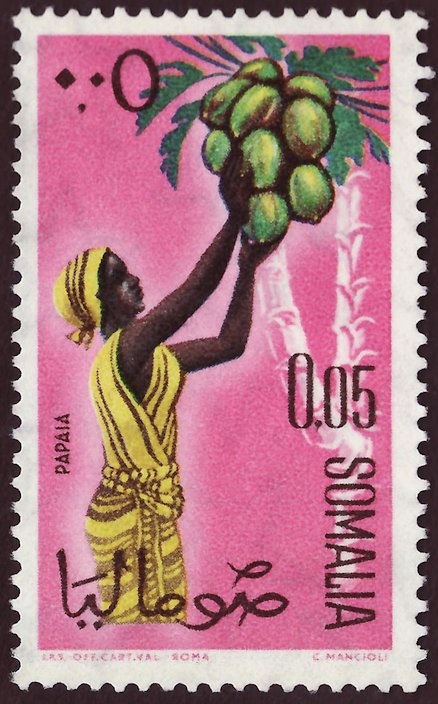
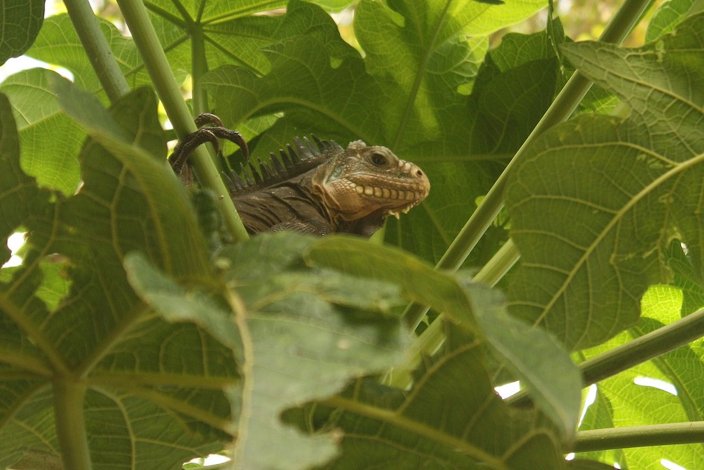
Fig. 42. Stamp of the Somali Republic (Somalia); 1961 Fig. 43. Lesser Antillean Iguana (Iguana delicatissima) in a papaya tree (C. papaya) Picard, Dominica
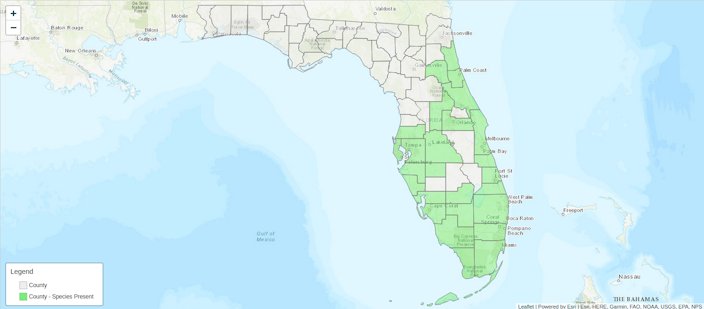
Fig. 44. Papaya distribution map, wild populations Further Reading More Images and Information Papaya Carica, Handbook of Energy Crops Papaya, Crop Knowledge Master, University of Hawai'i Papaya, Archives of the Rare Fruit Council of Australia A New Pawpaw, Archives of the Rare Fruit Council of Australia Papaya Post Harvest Operations, Food and Agriculture Organization of the United Nations pdf Papaya Proliferation, Eat the Weeds List of Growers and Vendors |
||||||||||||||||||||||||||||||||||||||||||||||
| Bibliography 1 Crane, Jonathan. "Papaya Growing in the Home Landscape." Horticultural Sciences Dept., UF/IFAS Extension, Original pub. Apr. 1994,Revised Oct. 2005, Oct. 2008, Revised Nov. 2016, Reviewed 24 July 2023, doi.org/10.32473/edis-mg054-2005, AskIFAS, edis.ifas.ufl.edu/054. Accessed 2 Mar. 2017, 12 Apr. 2020, 31 Oct. 2025. 2 Gilman, Edward, F., et al. "Carica Papaya Papaya." Environmental Horticulture Dept., UF/IFAS Extension, Oct. 1999, Revised Dec. 2018, Reviewed 7 Nov. 2024, AskIFAS, doi.org/10.32473/edis-fp106-1999, edis.ifas.ufl.edu/fp106. Accessed 2 Mar. 2017, 13 Apr. 2020, 2 Nov. 2025. 3 Chia, C. L., and M. Manshardt. "Why some papayas fail to fruit." College of Tropical Agriculture and Natural Resources, University of Hawaii, at Mānoa, Cooperative Extension Service, Oct. 2001, CTAHR, ctahr.hawaii.edu. Accessed 15 Jan. 2014. 4 Fruits of Warm Climates. Julia F. Morton, Miami, 1987. 5 "Papaya biology." International Fruits Network, itfnet.org. Accessed 9 Sept. 2016. 6 Deane, Green. "Papaya Proliferation." Eat the Weeds and other things, too. www.eattheweeds.com/carica-papaya-survivalist-plant-2/. Accessed 5 July 2017. 7 "Papaya common names." World Crops Database, world-crops.com/papaya/. Accessed 5 Nov. 2025. 8 Paull, Robert E., and Odilo Duarte. Tropical Fruits, Volume I. 2nd ed., Cambridge, CABI, 2011. 9 "Papaya." California Rare Fruit Growers, crfg.org.pubs/ff/papaya.html. Accessed 25 Sept. 2020. 10 Villegas, V. N. "Carica papaya L." Edible fruits and nuts, Plant Resources of South-East Asia No 2, Edited by Verheij, E. W. M., and R. E. Coronel, PROSEA Foundation, Bogor, Indonesia, PROSEA, (CC BY-NC-SA 3.0), www.prota4u.org/prosea/view.aspx?id=1484. Accessed 25 Sept. 2020. 11 Chia, C. L., et. al., and T. V. Tripton, et. al. "Papaya." Crop Knowledge Master, University of Hawai'i, Extension Service, extento.hawaii.edu./kbase/crop/crops/i_papa.htm. Accessed 25 Sept. 2020. 12 Ward, Dan. "Native or Not: Studies of problematic species." The Palmetto, No. 6 in the Series, Vol 28:1, Winter/Spring 2011, The Institute for Regional Conservation, www.regionalconservation.org/ircs/pdf/Ward_2011.pdf. Accessed 5 Nov. 2025. 13 Duke, James A. "Carica papay L." Handbook of Energy Crops, Purdue University, Center for New Crops and Plant Products, unpublished, 1983, NewCROPTM, hort.purdue.edu/newcrop/duke_energy/Carica_papaya.html. Accessed 6 Nov. 2025. 14 Wunderlin, R. P., et al. "Carica papaya." Institute for Systematic Botany, University of South Florida, Tampa, S. M. Landry, and K. N. Campbell, USF Water Institute, 2025, Atlas of Florida Plants, florida.plantatlas.usf.edu/plant/species/1699. Accessed 5 Nov. 2025. 15 Sauls, Julian W. "Papaya" Fruit & Nut Resources, Texas A&M Agrilife Extension, aggie-horticulture.tamu.edu/fruit-nut/fact-sheets/papaya/. Accessed 5 Nov. 2025. Videos v1,2,3,4,5,6 Crane, Johathan H., and Ian Maguire. "Cultural practices for the papaya." University of Florida, IFAS/TREC. Photographs Fig. 1,12,27 "Carica papaya." Top Tropicals, toptropicals.com. Accessed 29 Mar. 2014. Fig. 2 Vegan Feast Catering. "Peppery Papaya." Flickr, 9 Feb. 2010, (CC BY 2.0), www.flickr.com/photos/25128194@N02/4343988157. Accessed 12 Aug. 2020. Fig. 3,17,20,39 Jackson, Karen. "Papaya Series." 2013, www.growables.org. Fig. 4 User Phyzome. "Carica papaya, Tropical Dwarf papaya. Leaf close-up." Wikimedia Commons, 20 May 2005, GFDL, commons.wikimedia.org/wiki/File:Carica_papaya_-_Papaya_-_var-tropical_dwarf_papaya_-_desc-leaf.jpg. Accessed 22 Sept. 2020. Fig. 5 Joydeep. "Carica papaya leaf." Wikimedia Commons, 2012, (CC BY-SA 3.0), commons.wikimedia.org. Accessed 9 Sept. 2016. Fig. 6 Valke, Dinesh. "Caricaceae (carica family), Carica papaya. Thane, India." Wikimedia Commons, via Flickr, 21 July 2007, (CC BY-SA 2.0), commons.wikimedia.org/wiki/File:Carica_papaya_♂_(864058278).jpg. Accessed 22 Sept. 2020. Fig. 7 Somiah, Kalaivani. "Carica papaya, flowers on male plant." Wikimedia Commons, 11 June 2012, (CC BY-SA 3.0), commons.wikimedia.org/wiki/Category:Carica_papaya#/media/File:5_flower_3.JPG. Accessed 22 Sept. 2020. Fig. 8 Rulkens, Tom. "Carica papaya male flowers in Mozambique, Africa." Wikimedia Commons, via Flickr, 4 Mar. 2012, (CC BY-SA 2.0), commons.wikimedia.org/wiki/File:Carica_papaya_-_male_flowers.jpg. Accessed 21 Sept. 2020. Fig. 9 Jacob, Reji. "Male plant of Papaya. In male plant, flowers are not turn out to fruits." Wikimedia Commons, 23 May 2011, (CC BY-SA 3.0), commons.wikimedia.org/wiki/File:Male_Plant_of_Papaya.jpg. Accessed 22 Sept. 2020. Fig. 10 Ganguly, Biswarup. "Papaya flower in small papaya tree is about 7 ft height in Kolkata." Wikimedia Commons, 13 Oct.2010, (CC BY 3.0), GFDL, commons.wikimedia.org/wiki/File:Carica_papaya_Flower_7770.JPG. Accessed 11 Aug. 2020. Fig. 11 Mercadante, Mauricio. "Carica papaya L., Caricaceae." Flickr, 21 Feb. 2012, (CC BY-NC-SA 2.0), www.flickr.com/photos/mercadanteweb/6958754600/in/photolist-eSxJDU-eSmiVK-eSxJhN-bAVriA-bPQ5Qi. Accessed 21 Sept. 2020. Fig. 13,14 Starr, Forest, and Kim. "Carica papaya. Female flower on right hemaphrodite flower on left." Starr Environmental, Hawea Pl Olinda, Maui, 2012, starrenvironmental.com. Accessed 1 Apr. 2014. Fig. 15 Yosri. "Close-up of female flowers and immature fruits." Tropical Plants Database, GFDL, tropical.theferns.info. Accessed 9 Sept. 2016. Fig. 16 TRAPHITHO. Pixabay, pixabay.com/photos/fruit-nature-papaya-edible-2741222/. Accessed 12 Aug. 2020. Fig. 18 Stang, David. "Papaya carica." Tropicos®, Missouri Botanical Garden, 12 Aug 2020, (CC BY-NC-SA 3.0), www.tropicos.org/Image/100109206. Accessed 20 Sept. 2020. Fig. 19 Zell, H. "Carica papaya, Caricaceae, Papaya, fruits; Botanical Garden KIT, Karlsruhe, Germany. The leaves are used in homeopathy as remedy: Carica papaya." Wikimedia Commons, 18 Oct. 2009, GFDL, (CC BY-SA 3.0), commons.wikimedia.org/wiki/Category:Carica_papaya_(fruit)#/media/File:Carica_papaya_005.JPG. Accessed 22 Sept. 2020. Fig. 21 Danielrengelm. "Corte transversal del fruto aun inmaduro de un papayo (especie Carica papaya)." Wikimedia Commons, 6 Feb. 2009, (CC BY-SA 3.0), commons.wikimedia.org/wiki/File:Carica_papaya_corte.jpg. Accessed 22 Sept. 2020. Fig. 22 Gener. "Carica papaya seeds - with and without skin." Wikimedia Commons, via German Wikimedia, 17 Aug. 2011, GFDL, (CC BY-SA 3.0), commons.wikimedia.org/wiki/File:Carica_papaya_-_Seeds_-_with_and_without_skin.jpg. Accessed 20 Sept. 2020. Fig. 23 Hurst, Steve. "Carica papaya L. - papaya." USDA, NRCS, National Plant Data Team, Greensboro, NC 27401-4901 USA, 2020, The PLANTS Database, plants.usda.gov. Accessed 12 Aug. 2020. Fig. 24 Bemowski, Traper. "Papaya seedling." Wikimedia Commons, 28 Feb. 2014, (CC BY 3.0), commons.wikimedia.org/wiki/File:Carica_papaya_seedling.jpg. Accessed 20 Sept. 2020. Fig. 25 Vijayanrajapuram. "A sleedling of Red Lady." Wikimedia Commons, 7 Mar. 2017, (CC BY-SA 4.0), commons.wikimedia.org/wiki/Category:Carica_papaya_(seedlings)#/media/File:RedLady_seedling.jpg. Accessed 20 Sept. 2020. Fig. 26 Downtowngal. "Healthy seedling of Mexican papaya (Carica papaya) has about 8 true leaves. There are tiny balls of sap on the main stem and leaf stems." Wikimedia Commons, 27 June 2017, (CC0 1.0), commons.wikimedia.org/wiki/File:Sap_droplets_on_Carica_papaya_seedling.jpg. Accessed 23 Sept. 2020. Fig. 28 Fern, Ajna. "Growing in a woodland garden, Brazil." Useful Tropical Plants Database, (CC BY-NC-SA 3.0), tropical.theferns.info. Accessed 9 Sept. 2016. Fig. 29 Stang, David J. "Carica papaya L., Longwood Gardens, Kennett Square, Pennsylvania." Wikimedia Commons, via ZipcodeZoo, 16 May 2007, (CC BY-SA 4.0), commons.wikimedia.org/wiki/File:Carica_papaya_34zz.jpg. Accessed 11 Aug. 2020. Fig. 30 Stang, David J. "Carica papaya L., Longwood Gardens, Kennett Square, Pennsylvania." Wikimedia Commons, via ZipcodeZoo, 16 May 2007, (CC BY-SA 4.0), Image cropped, commons.wikimedia.org/wiki/File:Carica_papaya_23zz.jpg. Accessed 11 Aug. 2020. Fig. 31 Lulu8506. Pixabay, pixabay.com/photos/papaya-fruit-food-orange-green-4470223/. Accessed 12 Aug. 2020. Fig. 32 Vegan Feast Catering. "Lemoned Papaya Carpaccio with Sprouts." Flickr, 9 Feb. 2010, (CC BY 2.0), www.flickr.com/photos/veganfeast/4344947481/. Accessed 12 Aug. 2020. Fig. 33 Rodrigues, Leah. "Refreshing Thai Green Papaya Salad." Foodista, 20 May 2012, (CC BY 3.0), www.foodista.com/blog/2012/05/20/refreshing-thai-green-papaya-salad. Accessed 12 Aug. 2020. Fig. 34 The Duo Dishes. "Papaya Black Bean Salsa." Foodista, 1 Oct. 2012, (CC BY 3.0), www.foodista.com/recipe/recipe/H4G7LZWJ/papaya-black-bean-salsa. Accessed 12 Aug. 2020. Fig. 35 Vegan Feast Catering. "Avo Papaya Salad." Flickr, 24 Oct. 2009, (CC BY 2.0), www.flickr.com/photos/veganfeast/4467442549/. Accessed 12 Aug. 2020. Fig. 36 Vegan Feast Catering. "Papaya Bread." Flickr, 27 Mar. 2010, (CC BY 2.0), www.flickr.com/photos/veganfeast/4041097163/. Accessed 12 Aug. 2020. Fig. 36 sangeetha. "Papaya Banana Smoothie." Foodista, 29 Mar. 2011, (CC BY 3.0), www.foodista.com/recipe/B78F2P6K/papaya-banana-smoothie. Accessed 12 Aug. 2020. Fig. 38 kamusta23. Pixabay, pixabay.com/photos/panacotta-vegan-dessert-tropical-1514463/. Accessed 12 Aug. 2020. Fig. 40 Dupont, Bernard. "Toco Toucan (Ramphastos toco) eating Papaya (Carica papaya). Poconé, Mato Grosso, Brazil." Wikimedia Commons, 21 June 2016, (CC BY-SA 2.0), commons.wikimedia.org/wiki/File:Toco_Toucan_(Ramphastos_toco)_eating_Papaya_(Carica_papaya)_(28378476504).jpg. Accessed 23 Sept. 2020. Fig. 41 Ruestz. "Alouatta pigra (Howler monkey), eating leaves of Carica papaya (Costa Rica, peninsula Nicoya, Cabo-Blanco)." Wikimedia Commons, 16 Mar. 2002, GFDL, (CC BY-SA 3.0), Image cropped, commons.wikimedia.org/wiki/Carica_papaya#/media/File:Howler_monkey20020316.JPG. Accessed 22 Sept. 2020. Fig. 42 "Stamp of the Somali Republic (Somalia); 1961." Postal administration for Somalia, Wikimedia Commons, Public Domain, commons.wikimedia.org/wiki/File:SOM_1961_MiNr0016_mt_B002.jpg. Accessed 20 Sept. 2020. Fig. 43 Postdlf. "Lesser Antillean Iguana (Iguana delicatissima) in a papaya tree (Carica papaya) Picard, Dominica." Wikimedia Commons, 6 Mar. 2012, (CC BY-SA 3.0), commons.wikimedia.org/wiki/File::Iguana_delicatissima_in_Picard,_Dominica-2012_03_06_0517.jpg. Accessed 20 Sept. 2020. Fig. 44 Wunderlin, R. P., et al. "Carica papaya, Distribution range." Institute for Systematic Botany, University of South Florida, Tampa, S. M. Landry, and K. N. Campbell, USF Water Institute, 2025, Atlas of Florida Plants, florida.plantatlas.usf.edu/plant/species/1699. Accessed 5 Nov. 2025. * UF/IFAS Assessment of Non-native Plants in Florida's Natural Areas ** Information provided is not intended to be used as a guide for treatment of medical conditions. Published 20 Oct. 2013 LR. Last update 7 Nov. 2025 LR |
|||||||||||||||||||||||||||||||||||||||||||||||