| California Fan Palm - Washingtonia filifera | ||||
|---|---|---|---|---|
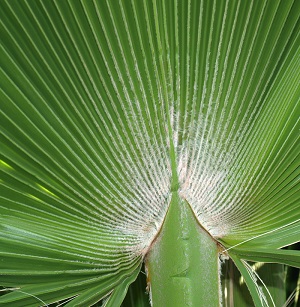
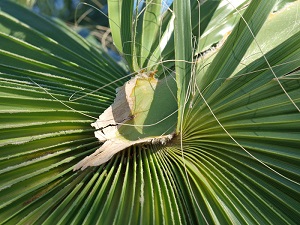
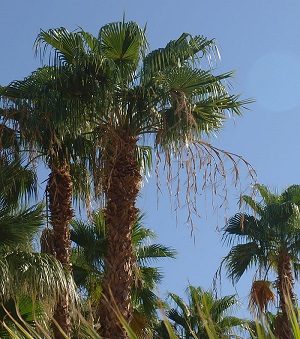
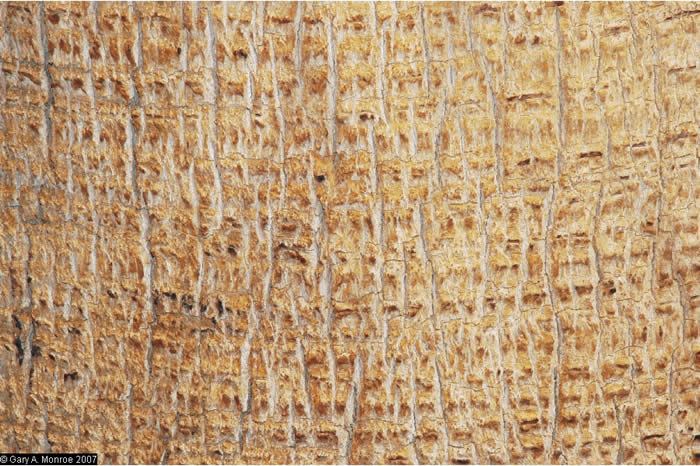
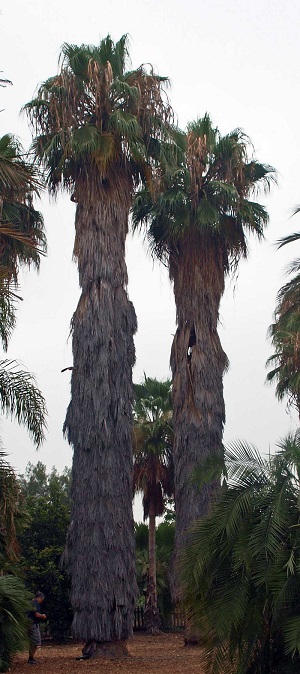 Fig. 1 W. filifera palms showing marcesant leaves with human on the left (for scale) 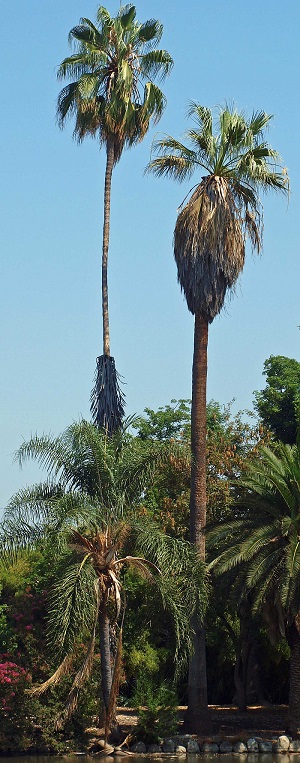 Fig. 2 W. robusta (left) W. filifera (right) 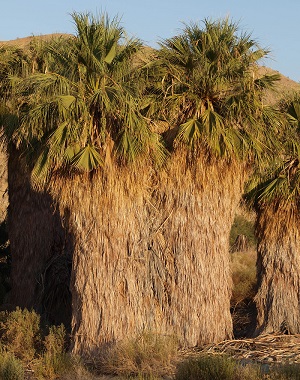 Fig. 3 W. filifera habit, Coachella Valley Preserve, Thousand Palms Oasis 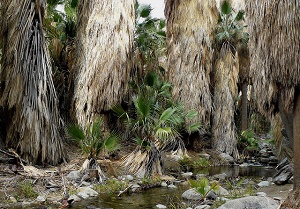 Fig. 4 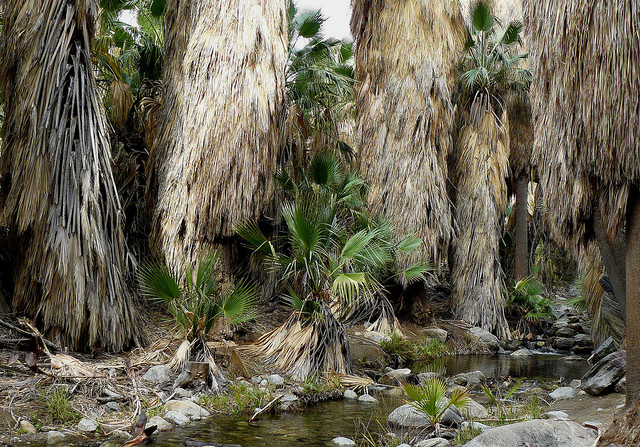 Desert Palm, W.filifera, Indian Canyons, Palm Springs Ca. 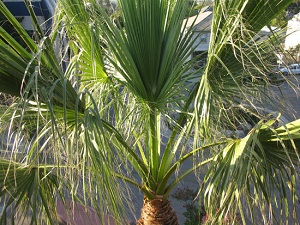 Fig. 5 W. filifera with open canopy
Fig.
6
Fig.
7 Close-up
Fig.
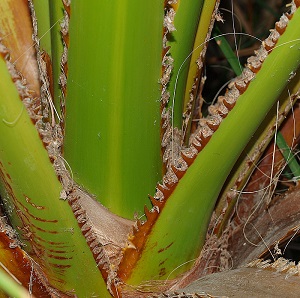
8 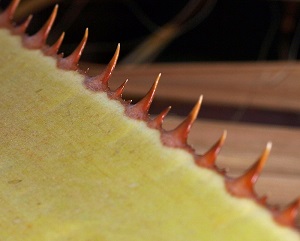 Fig. 9 W. filifera close view of teeth along petiole margin
Fig.
10
Fig.
11 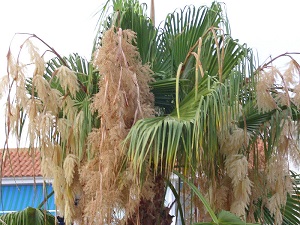
Fig.
12
Fig.
14
Fig.
15
Fig.
16
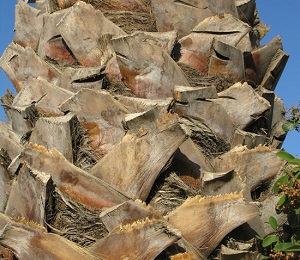
Fig. 18 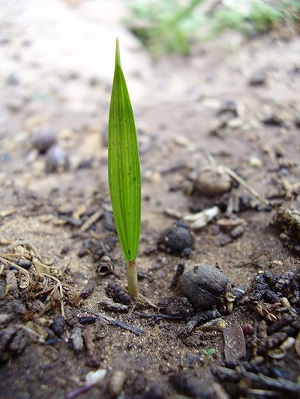
Fig.
19  Fig. 21
|
Scientific
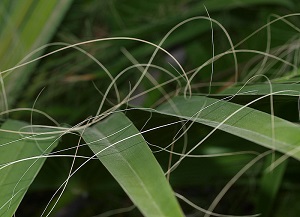
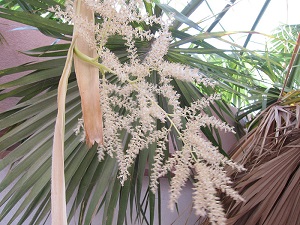
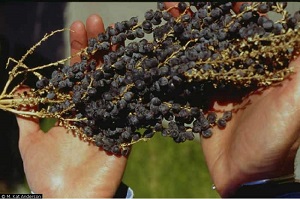
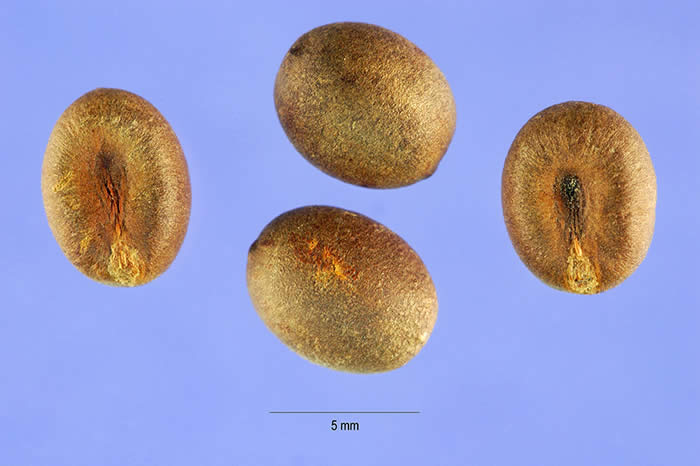
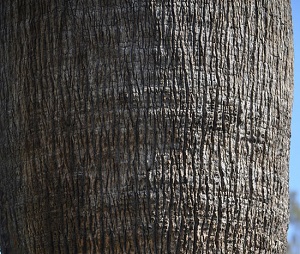
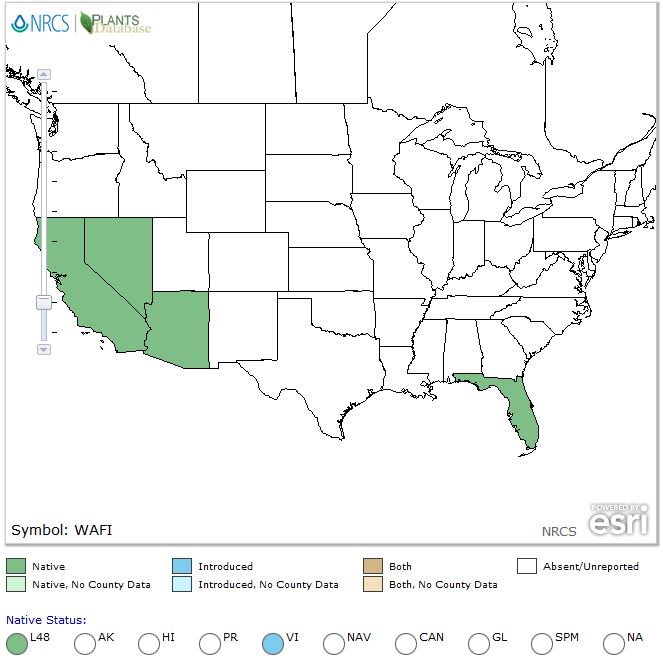
name W. filifera H. Wendl. Pronunciation wosh-ing-TOE-nee-uh fill-LIFF-er-uh 3 Common names California Washingtonia Palm, Desert Fan Palm, Petticoat Palm, American Cotton Palm, Cotton Palm, Washington Palm Synonyms Neowashingtonia filifera (Linden) Sudw.; Pritchardia filifera Linden ex André; W. filamentosa (H.Wendl. ex Fenzi) Kuntze; W. sonorae S.Watson Relatives Thread palm, Mexican Palm (W. robusta) Family Arecaceae/Palmae Origin Not native to North America USDA hardiness zones 9A-11 Uses The trees are especially valuable as avenue plants, and are widely used as such in southern California and Arizona; they also make handsome specimens Height To about 40 to 50 ft (1 5m), sometimes 80 ft (24 m) Spread 10-15 ft (3-4 m) 3 Crown Symmetrical; large, dense canopy of several dozen leaves Growth rate Moderate; 36 in. (91 cm) a year Trunk/bark/branches Branches don't droop; not showy; typically one trunk; thorns 3 Pruning requirement Needed for strong structure 3 Leaves Evergreen; immense, fan-shaped, costapalmate, grayish-green leaves are 3-4 ft (1-1.5 m) long and 6-7 ft (1.5-2 m) wide, dividing about halfway into 50-70 pointed segments that bend and split at the tips with threads in between; Petioles of mature palms are armed along the margins with curved thorns (Fig. 9) 4,9 Flowers Numerous white to apricot, bisexual flowers are borne on 9-15 foot arching, branched inflorescences that hang down from among the leaves; not showy 4 Fruit Fruits are spherical to pear-shaped, less than 0.5 in (1 cm) in diameter and brownish-black to black when ripe; berry-like, small fruits are brownish-black drupe and have a thin, sweet pulp that tastes somewhat like dates or butterscotch; each fruit contains a single seed 4 Light requirement Full Sun 3 Soil tolerances The trees are widely adaptable to most soil conditions, well-drained 3 pH preference 9A-11 Drought tolerance High drought tolerance but will do well with some moisture Wind tolerance Wind-tolerant Aerosol salt tolerance Moderate 3 Soil salt tolerance Moderate salt tolerance allows it to be used close to the coast in several of the southern states Cold tolerance They are hardy to 18° F (-7º C) Invasive potential * There is little invasive potential Pest resistance Resistant to pests/diseases; resistant to Verticillium wilt 3 Known hazard The dead fronds are known to be a fire hazard and a popular bedding roost for rodents and, because of this must be removed by law in some areas 3 Reading Material Washingtonia filifera: Desert Palm, University of Florida pdf Fan Palm, Washingtonia filifera, USDA Natural Resources Conservation Service pdf Origin California fan palms occur near streams and springs on borders of the Colorado Desert of California and southwest Arizona. The related W. robusta is native to arid regions of Sonora and Baja California, Mexico. The genus is named after George Washington, 1732-1799, the first president of the United States. 4 Description Solitary, columnar, upright to 50 feet (15 m) tall and 100-150 cm diameter, covered with a skirt of marcescent leaves (unless removed for landscape appeal). Old leaf bases usually fall away after many years, to leave a smooth gray stem with closely spaced leaf scar rings. 1 These palms are extensively grown in many parts of California and are common along the Gulf Coast and in Florida, as well as in other parts of the world, particularly those with Mediterranean-type climates. 1 The cylindrical, closely ringed and fissured trunks are swollen at the base and covered with a "petticoat" of dead, pendant leaf stalks, extending almost to the ground. They are not a particularly good choice for container culture because of their relatively fast rate of growth. 1 The specific epithet filifera means "thread-bearing". 5 Palm Morphology and Anatomy, University of Florida pdf Leaves The leaves are costapalmate, induplicate, split about half the blade length into numerous segments with pendulous tips and threads (marginal fibers) hanging between segments. Several grayish-green leaves form an open crown. Petioles split, armed with curved teeth. The base of the lower surface of the leaf blade scantly covered with near white pubescence. The adaxial hastula is prominent with tattered margins. The leaves are edged with prickles and stand well apart in an open crown. 1 Flowers The California fan palm produces numerous branching flower clusters that project out and often downward from the leaf crown. The bisexual blossoms are white and yellow and give rise to oblong or round red-black fruit, each about a 0.5 in (1.3 cm) in diameter. 5 Fruit Does not attract wildlife; not showy; fruit/leaves not a litter problem. 3 Diagram of the seed, USDA Natural Resources Conservation Service Pollination Pollination is by wind and various insects. Propagation Propagation is from seed, which germinate in six weeks to two months. 4 Palm Seed Germination, University of Florida pdf Planting Plant this palm only on soil which is extremely well-drained to prevent trunk or root rot. Moderate salt tolerance allows it to be used close to the coast in several of the southern states. This palm could be tried more in well-drained sites as a replacement for Washingtonia robusta which grows very tall with a skinny trunk. 3 Container Production of Palms, University of Florida pdf Cold Damage in Palms, University of Florida pdf Pruning The lower leaves persist on the tree after they die, forming a dense, brown, shaggy covering below the living, grey/green, broad, fan-shaped leaves, giving it the common name of Petticoat Palm. These dead fronds are known to be a fire hazard and a popular bedding roost for rodents and, because of this, must be removed by law in some areas. 3 Fertilizing The trees respond to an occasional light fertilizing, particularly when young. Older trees seem to do well without regular fertilizing. Fertilization of Field-Grown and Landscape Palms in Florida, University of Florida pdf Nutrition and Fertilization of Palms in Containers, University of Florida pdf Potassium Deficiency in Palms, University of Florida pdf Potassium Deficiency of Palms in Hawai'i, University of Hawai'i at Mānoa pdf Magnesium Deficiency in Palms, University of Florida pdf Nutrient Deficiencies of Landscape and Field-Grown Palms in Florida, University of Florida pdf Irrigation The palms are drought-tolerant but appreciate some moisture. In native stands they always grow near springs or other moist spots. Will frequently develops trunk or root rot when over-irrigated. 1,4 Pests/Diseases Scales while young, palm weevil in old age, palm leaf skeletonizer and a variety of scales at any time can infest this palm. Trunk or root rot in wet soils may infect this tree. 3 Resistant to verticillium wilt. 1 Pests and Diseases Other Injuries Symptoms Food Uses The small fruits are harvested when ripe and eaten fresh or dried, or made into jellies and drinks. The seeds are also edible and were widely used by Native Americans who ground them into meal for making bread or porridge. 4 Palm oases were important habitation sites for the Cahuilla and other tribes. The fan palm provided abundant fruit that was relished by the Cahuilla. It was eaten fresh or dried in the sun and then stored in ollas for future consumption. The seeds and flour were pounded into a meal, mixed with other flours and water to a mush. A beverage was made by soaking the fruit in water. 8 Other Uses Desert Fan Palm is better suited to the home landscape since it grows more slowly and is shorter. This also allows it to be used in more garden applications, such as containers or grouped together as a mass planting. 3 Additionally, the leaves were used for clothing, sandals, thatching, and basketry materials, the fruit stalks for fire drills, and leafstalks for household utensils. The Cahuilla, Diegueno, and Luiseno of southern California used the leaves for matting, stuffing and in rough ropemaking. 8 Better for the home landscape than the widely used W. robusa because it grows more slowly and is shorter, is also a good tree to use for dry urban landscapes, for example in Texas, Arizona and California. Select W. robusta for an irrigated landscape and for the eastern U.S. 3 General Plant this palm only on soil which is extremely well-drained to prevent trunk or root rot. This palm could be tried more in well-drained sites as a replacement for W. robusta which grows very tall with a skinny trunk. But over-irrigation and rainy weather could initiate root rot. They reportedly suffer and often die from root rot when irrigated. 3 May be confused with: Washingtonia robusta, but that species has a tapered stem, roughly twice as wide at the base as the apex, and bright green leaves forming a dense crown, rather than the columnar stemmed W. filifera, with grayish-green leaves and long petioles forming an open crown. 1 There is a persistent myth that these palms were brought to the Americas by the ancient Nubian's/Egyptians and their seeds were distributed in the waterways of the Western Californian area. 6
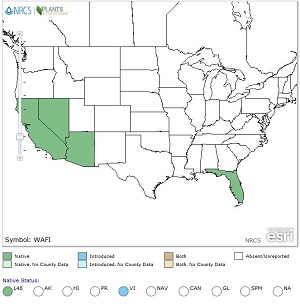
Fig. 20. Washingtonia filifera distribution map, wild populations Further Reading Edible Hardy Edible Palms, California Rare Fruit Growers (ext. link) Other Edible palm species: Cabbage Palm - Sabal palmetto Canary Island Date Palm - Phoenix canariensis Coconut Palm - Cocos nuficera Date Palm - Phoenix dactylifera Pindo Palm - Butia odorata Peach Palm - Bactris gasipaes List of Growers and Vendor |
|||
| Bibliography 1 Anderson, P.J. “Washingtonia filifera." Identifying Commonly Cultivated Palms, A Resource for Pests and Diseases of Cultivated Palms, Florida Department of Agriculture and Consumer Service, Division of Plant Industry and Identification Technology Program, CPHST, PPQ, APHIS, USDA; Fort Collins, CO. 2011, idtools.org/id/palms/palmid/. Accessed. 25 Mar. 2014. 2 Elliott, Monica L. "Bud Rot of Palm." Plant Pathology Dept., UF/IFAS Extension, PP-54, Original Pub. Jan. 2006, Rev. Oct. 2015, Reviewed 30 Nov. 2021, doi.org/10.32473/edis-pp144-2006, AskIFAS, ask.ifas.ufl.edu/pp144. Accessed 1 May 2014, 14 Mar. 2019, 25 Mar. 2014, 17 Mar. 2024, 20 July 2026. 3 Gilman, Edward F. and Watson, Dennis G. "Washingtonia filifera: Desert Palm." Environmental Horticulture Dept., UF/IFAS Extension, ENH-826/ST669, Original Pub. 1993, Revised Dec. 2006 and Apr. 2024, Released 8 May 2024, ask.ifas.ufl.edu/publication/ST669. Accessed 26 Sept. 2015, 21 July 2026. 4 "Edible Hardy Edible Palms: California Fan Palm." California Rare Fruit Growers, crfg.org/homepage/library/fruitfacts/93624-2/. Accessed 25 Apr. 2014. 5 Spencer, W. "A report regarding: The Palm - Washingtonia filifera - in Moapa NV." 1995, xeri.com/Moapa/wf-hr-part1.htm. Accessed 10 Dec. 2015. 6 "Washintonia filifera." Wikipedia, wikipedia.org. Accessed 10 Dec. 2015. 7 Haynes, Jody, and John McLaughlin. "Edible Palms and Their Uses." UF/Miami-Dade County Extension Office, MDCE-00-5, Original Pub. Nov. 2000, ask.ifas.ufl.edu. Accessed 14 Dec. 2015. 8 "Fan Palm, Washingtonia filifera (L. Linden) H. Wendl." USDA Natural Resources Conservation Service, Revised 19 June 2000, plants.sc.egov.usda.gov/DocumentLibrary/plantguide/pdf/cs_wafi.pdf. Accessed 12 Dec. 2015. Photographs Fig. 1,2,3,6,7,8,9,10,11 Anderson, P. J. "Washingtonia filifera." Identifying Commonly Cultivated Palms, A Resource for Pests and Diseases of Cultivated Palms, Florida Department of Agriculture and Consumer Service, Division of Plant Industry and Identification Technology Program, CPHST, PPQ, APHIS, USDA; Fort Collins, CO., 2011, idtools.org/id/palms/palmid/. Accessed 25 Mar. 2014. Fig. 4 Cory, Joyce. "Indian Canyons - Palm Springs Ca. Mature palms stand protectively around their young. Washingtonia filifera is the only palm native to California." Flickr, 2012, flickr.com. Accessed 13 Dec. 2015. Fig. 5,17,18 M. Ritter, et al. "Washingtonia filifera Tree Record." SelecTree, 1995-2015, selectree.calpoly.edu/tree-detail/1470. Accessed 12 Dec. 2015. Fig. 12 Martin, Javier. "W. filifera close up, Torrelamata, Torrevieja, Alicante, Spain." Wikipedia, 2010, wikimedia.org. Accessed 12 Dec. 2015. Fig. 13 Kaakkara, Shijan. "Washingtonia filifera Inflorescense." Wikipedia, 2013, (CC BY-SA 3.0), wikimedia.org. Accessed 12 Dec. 2015. Fig. 14 Anderson, M. Kat. "Washingtonia filifera." The PLANTS Database, 2014, USDA, NRCS, National Plant Data Team, Greensboro, NC 27401-4901 USA. plants.usda.gov. Accessed 25 Mar. 2014. Fig. 15 Hurst, Steve. "Washingtonia filifera." The PLANTS Database, 2014, USDA, NRCS, National Plant Data Team, Greensboro, NC 27401-4901 USA. plants.usda.gov..Accessed 25 Mar. 2014. Fig. 16 Monroe, Gary A. "Washingtonia filifera." The PLANTS Database, 2014, USDA, NRCS, National Plant Data Team, Greensboro, NC 27401-4901 USA. plants.usda.gov. Accessed 25 Mar. 2014. Fig. 19 RickP. "Washingtonia filifera seedling." Wikipedia, 2007, (CC BY 2.5), wikimedia.org. Accessed 12 Dec. 2015. Fig. 20 "Fan Palm, W. filifera (L. Linden) H. Wendl. distribution map." The PLANTS Database, USDA, NRCS, National Plant Data Team, Greensboro, NC 27401-4901 USA. plants.usda.gov. Accessed 15 Dec. 2015. Fig. 21 Hannawacker. "Oasis of Mara; Twentynine Palms, CA." Flickr, 14 Feb. 2024, Public Domain, www.flickr.com/photos/115357548@N08/12525470273/. Accessed 21 July 2026. * UF/IFAS Assessment of Non-native Plants in Florida's Natural Areas Published 25 Mar. 2014 LR. Last update 21 Aug. 2026 LR |
||||