| Salak - Salacca zalacca | ||||||||
|---|---|---|---|---|---|---|---|---|
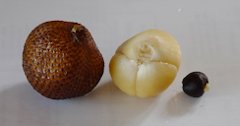
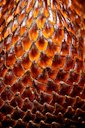
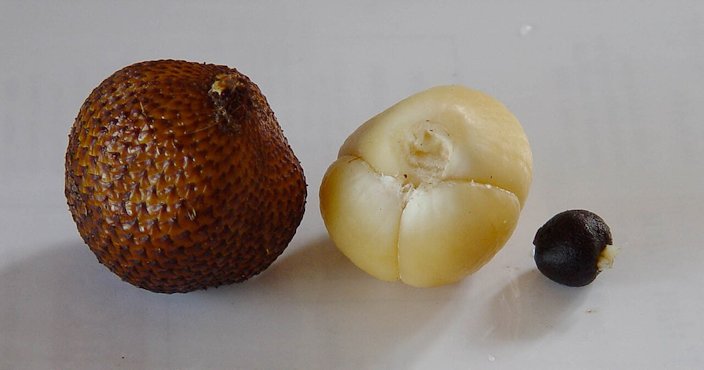
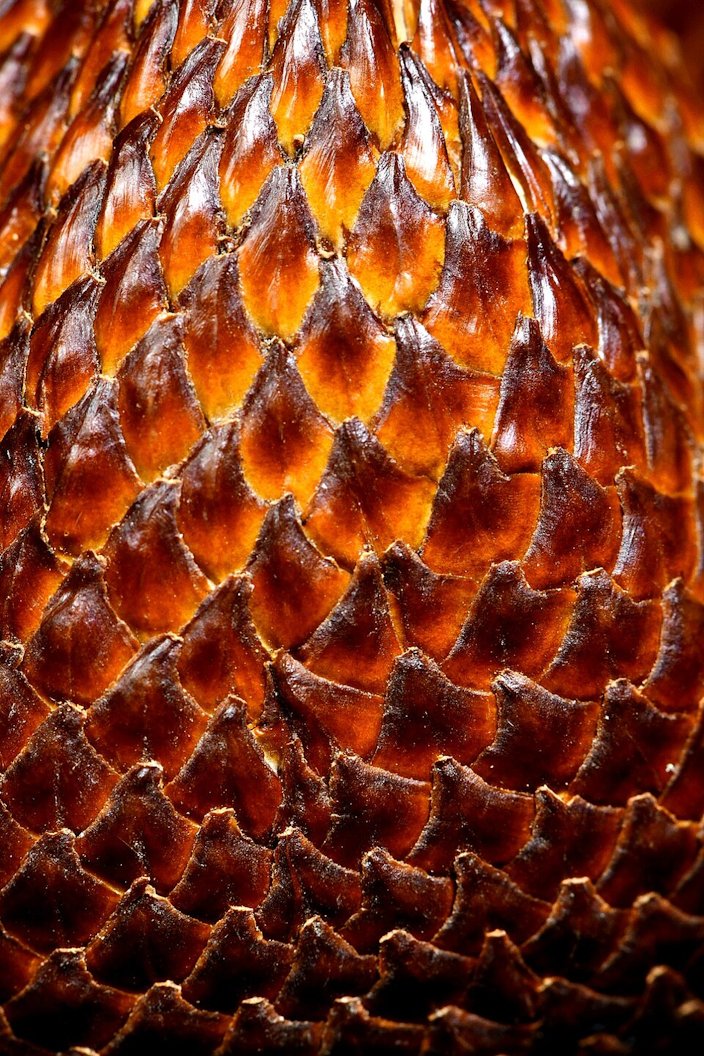
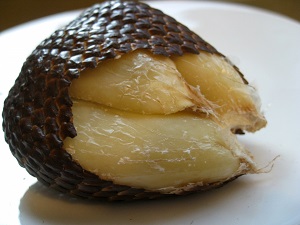 Fig. 1 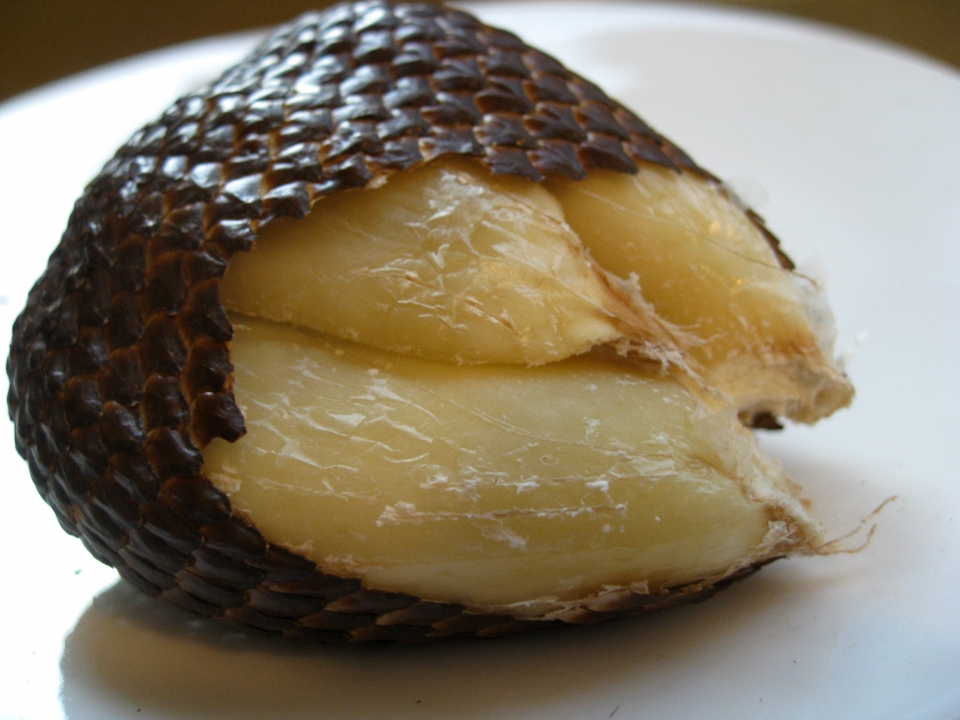 Ripe fruit, cut open to reveal the flesh 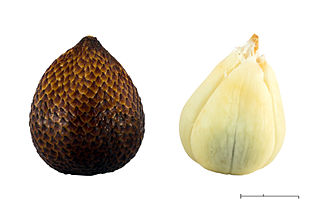 Fig. 2 Salak 'Pondoh' cultivar 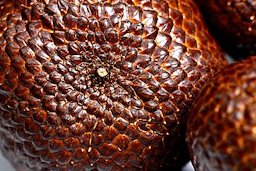 Fig. 3 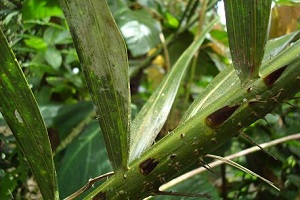 Fig. 4 Frond with spines along the petiole 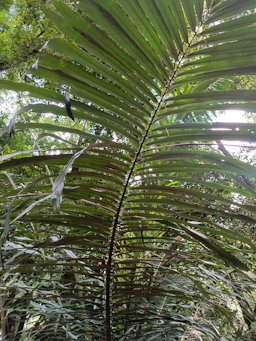 Fig. 5 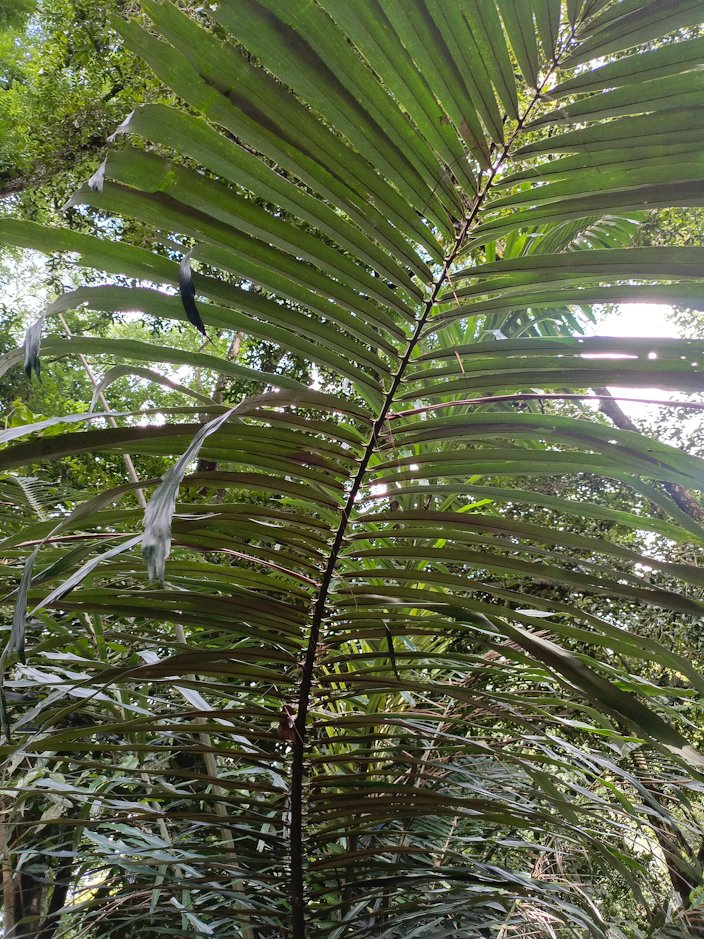 Leaf of Salacca zalacca (salak) in Ir. H. Djuanda Forest Park, Bandung 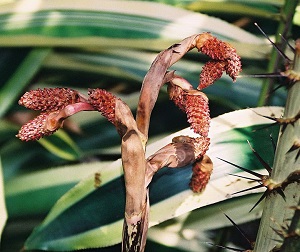 Fig. 6 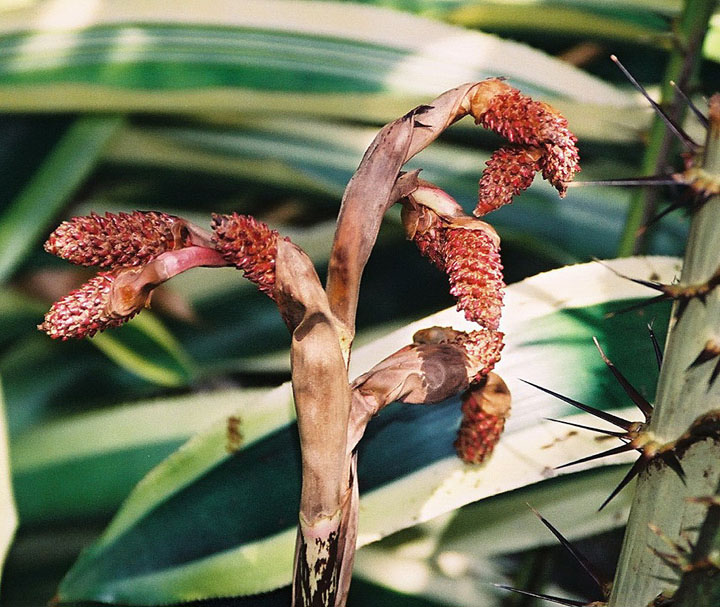 Inflorescence  Fig. 7 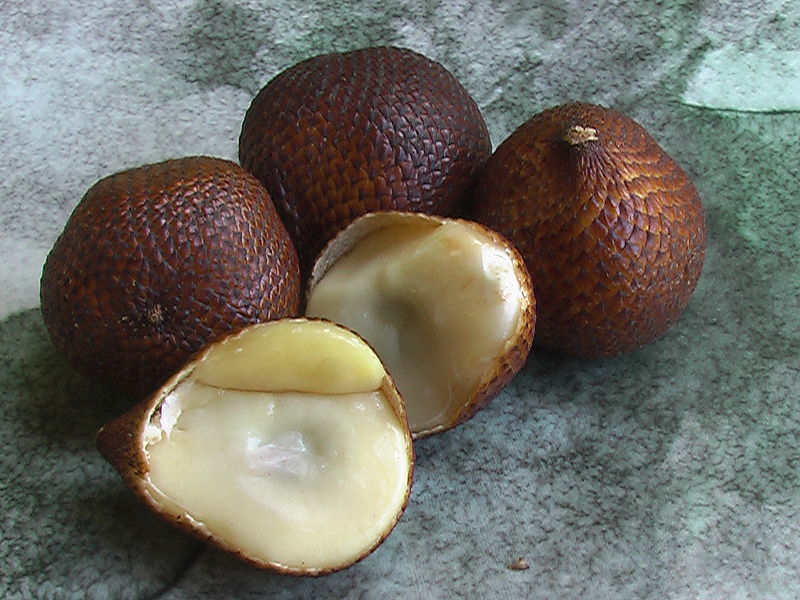 Salak, Salak (snakefruit) 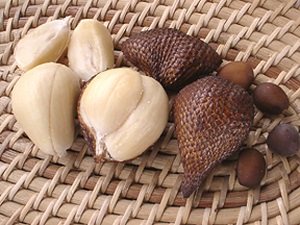 Fig. 8 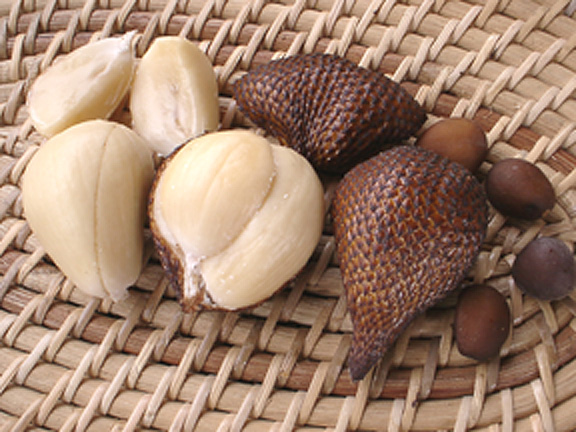 'Bali' 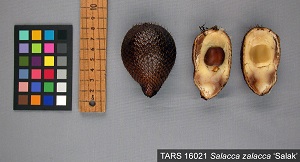 Fig. 9 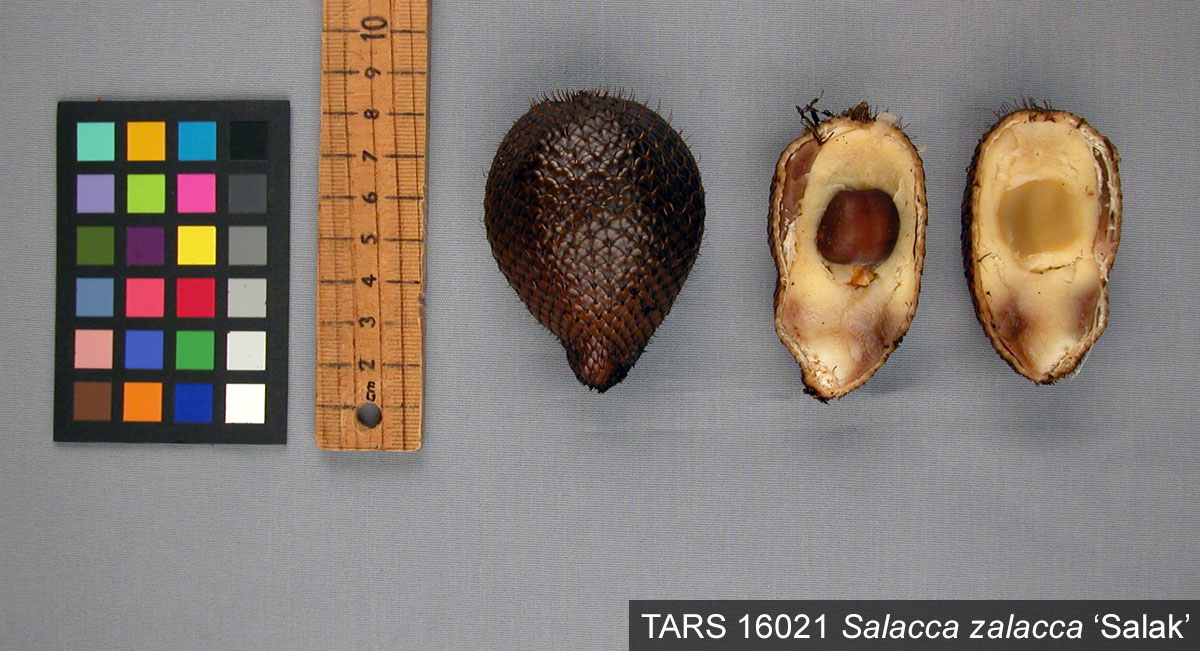 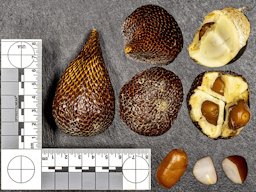 Fig. 10 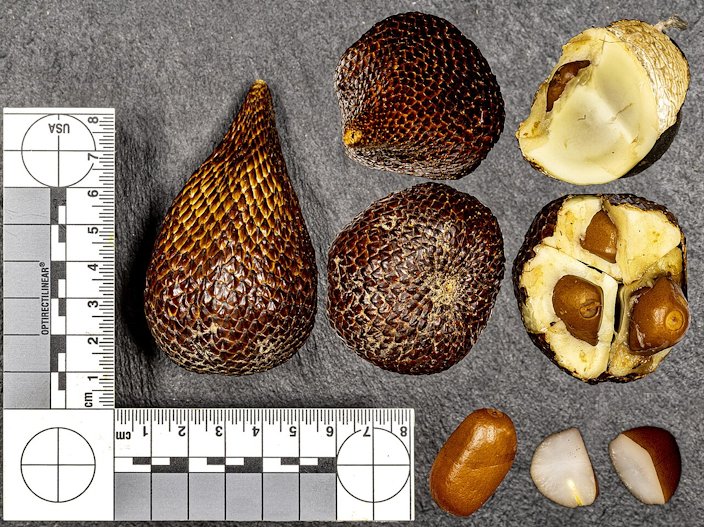 Fruit of the salak palm, Salacca zalacca, with cross-sections  Fig. 13 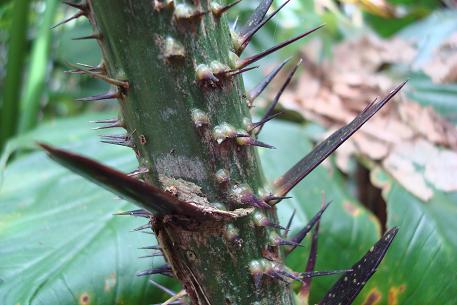 Thorny trunk 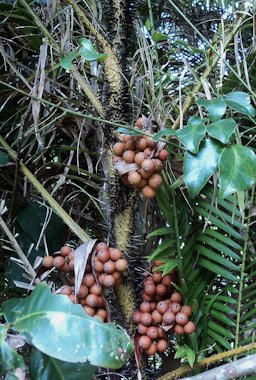 Fig. 14  Salacca zalacca, Viqueque, a city in the south-east of East Timor. (Fruit growing on the trunk) 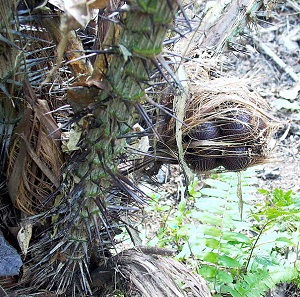 Fig. 15 This is some salak (snake fruit) growing on the tree in Bali (Fruit growing on the trunk) 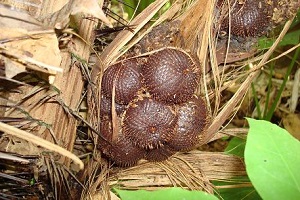 Fig. 16 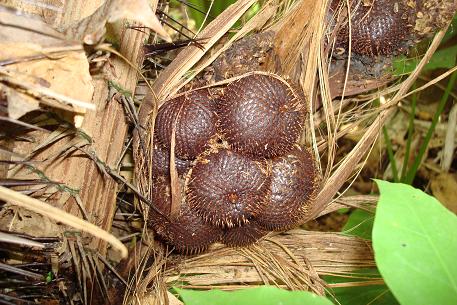 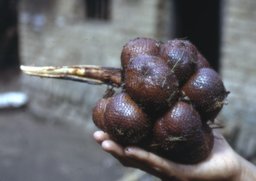 Fig. 17 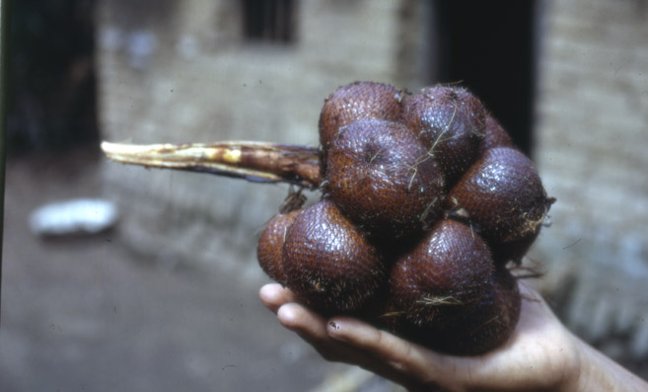 Salacca zalacca, Karangasem, Bali,  Fig. 18 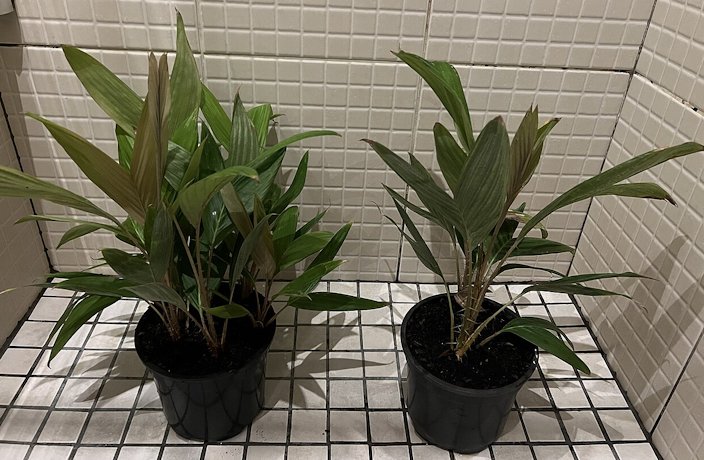 Salak Seedlings about 1 year old 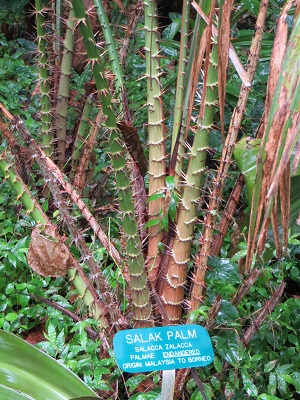 Fig. 19 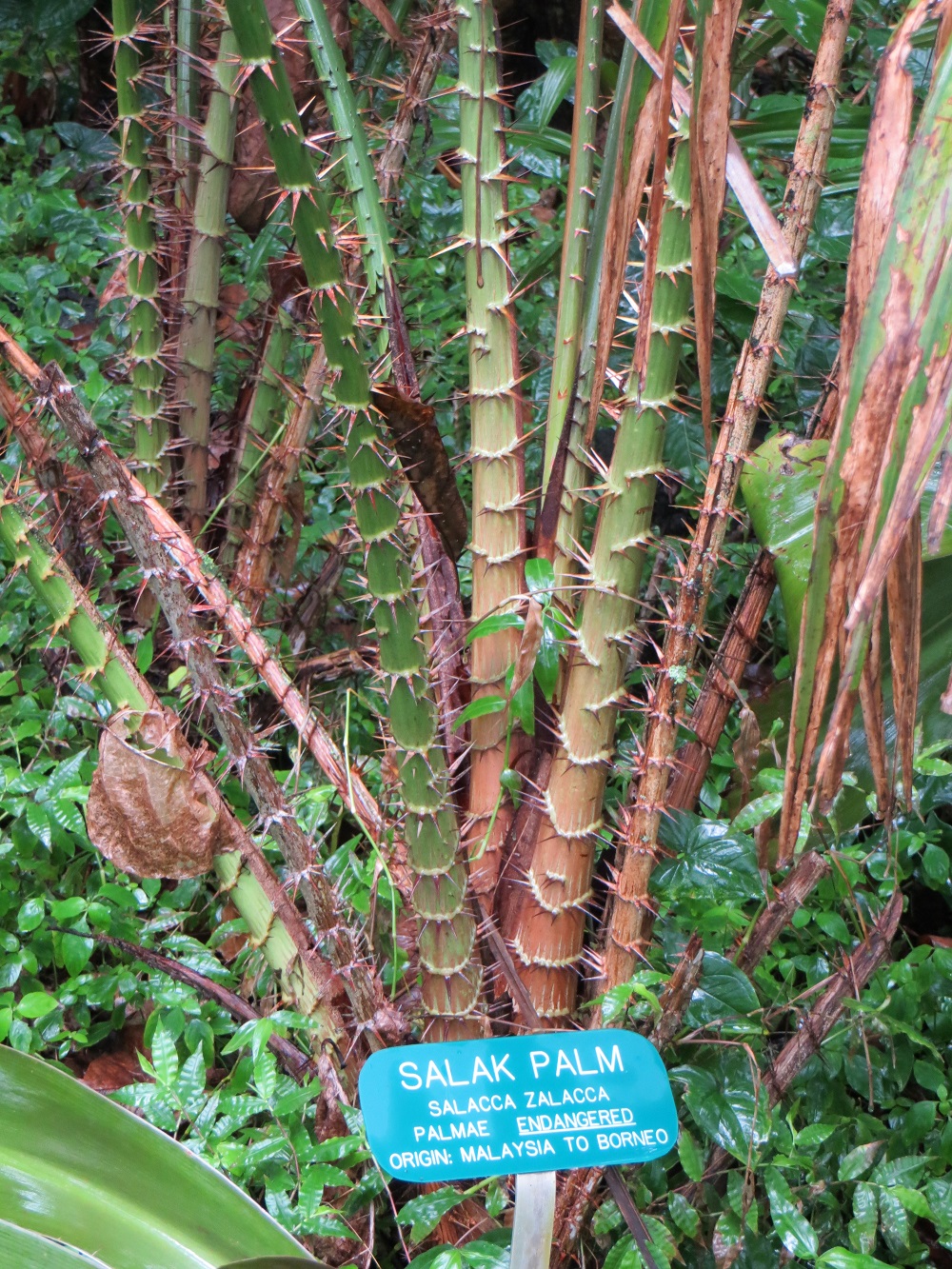 Cultivated plant in Hawai‘i Tropical Botanical Garden, Big Island 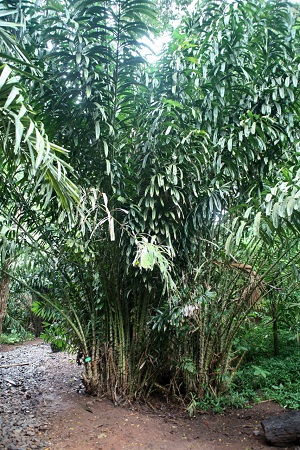 Fig. 20 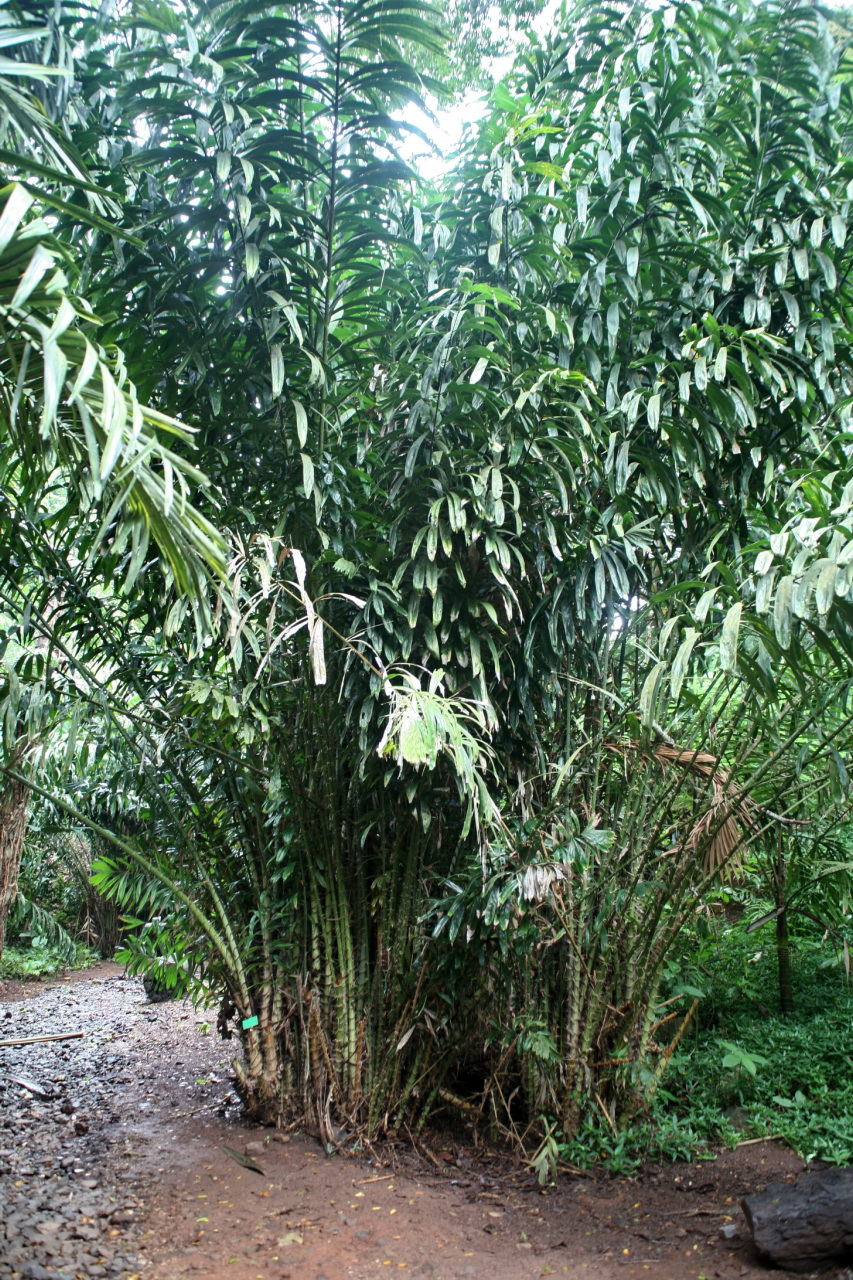 Plant growing in native habitat 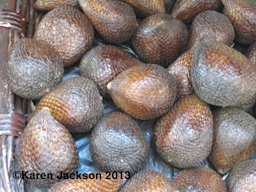 Fig. 21 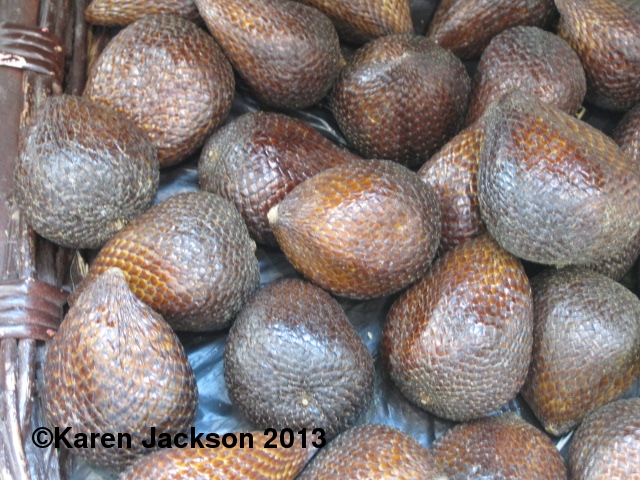 'Bali' fruit at market in Dubai 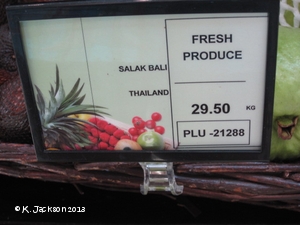 Fig. 22 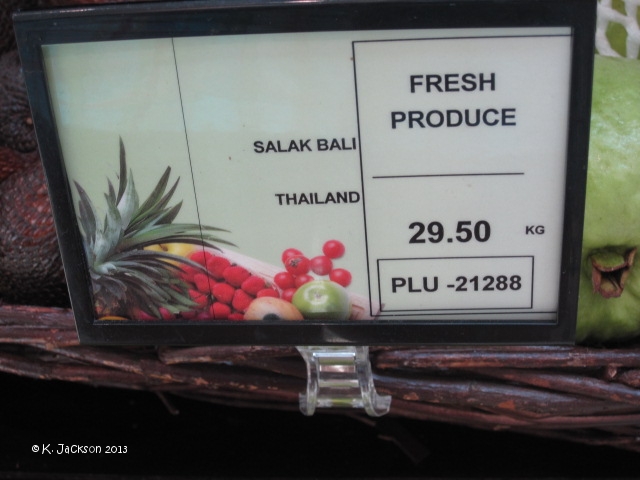 Salak fruit for sale at Dubai market 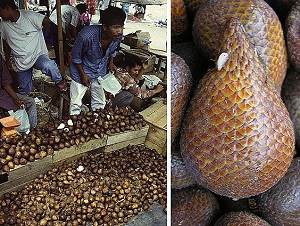 Fig. 23 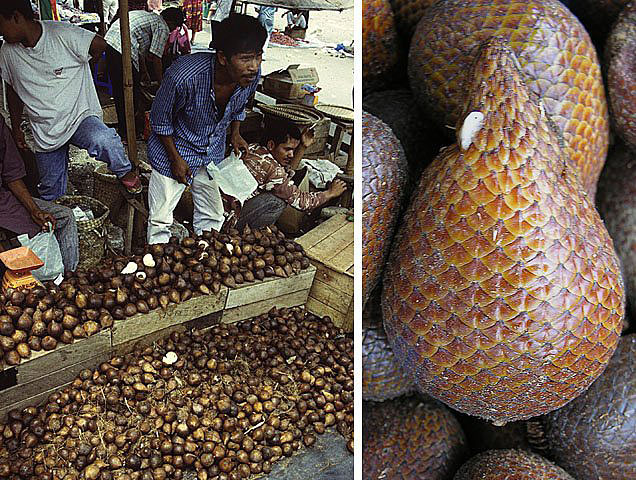 Fruits for sale in the market  Fig. 24 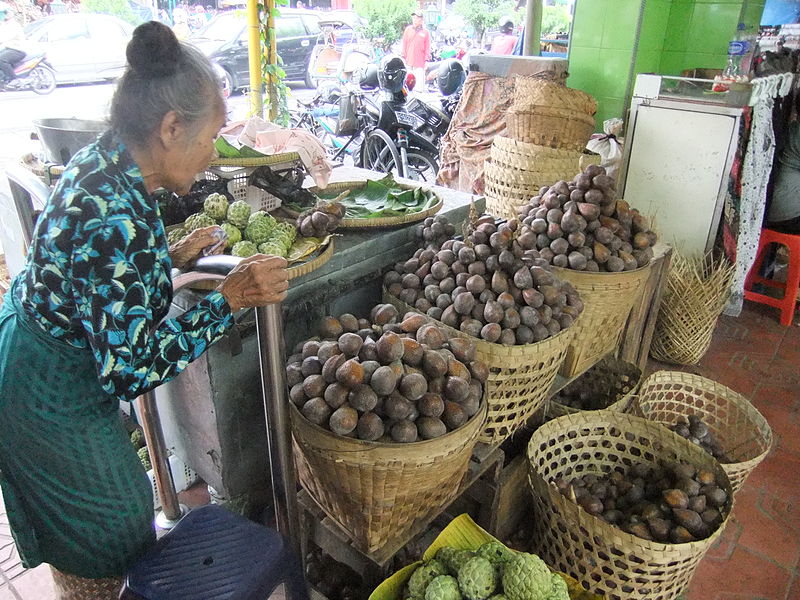 Salak 'Pondoh', Bahasa Indonesia 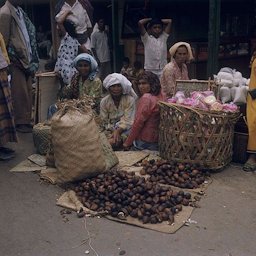 Fig. 25 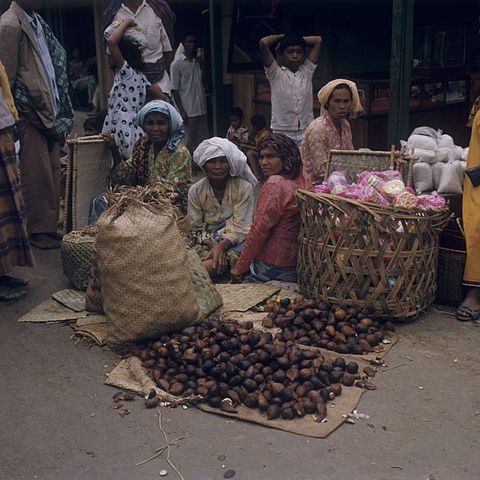 Women selling salak and krupuk at the market
|
Scientific
name Salacca zalacca (Gaertn.) Voss Common names English: salak, salak palm, snakefruit; German: Salakpalme; Swedish: salak 11 Synonyms Calamus zalacca Gaertn.; S. edulis Reinw.; C. salakka Willd. ex Steud.; S. blumeana Mart.; S. edulis var. amboinensis Becc. Mogea; S. rumphii Wall. [Illegitimate] 10 Family Arecaceae Origin Malesia: Indonesia, Java, Sumatra Uses Edible fruit, hedge, fences 4 Height Grows to 10 ft (3m) Spread Small cluster palm Plant habit Prostrate/procumbent/semi-erect 1 Longevity Can be productive for 50 years of more 12 Trunk/bark/branches Prickly, stemless clumping palm; trunk is underground Leaves Evergreen; pinnate fronds; 13-23 ft (4-7 m) long; leaf sheaths, petioles and leaflets armed with numerous long, thin, grey to blackish spines Flowers Dioecious; male and female plants are required for fruiting Fruit Rich yellow-white meat is slightly crisp, delicate delicious blend of acidity and sugars; characterized by its reddish-brown scaly skin 8,13 USDA Nutrient Content (pdf) Season In principle, this palm flowers and fruits continuously throughout the year but still has peak periods; a dependable South Florida harvest season has not been established Light requirement Semi-shade is essential for these palms; at least 30% shade for the first 3 years by way of shade cloth or shade trees i. e. under existing fruit trees 7,9 Soil tolerances Appears to grow well on calcareous limestone soils 8 pH preference 6.0-7.0 Drought tolerance Prefers moist conditions; because of its superficial root system it requires a high water table during most of the year Cold tolerance Very cold sensitive; has to be kept above 50°F (10°) Plant spacing 2-6 ft (0.6-1.8 m) 12 Roots Roots not extending to great depth Invasive potential * None known Known hazard Thorns Reading Material The Salak Palm, Archives of the Rare Fruit Council of Australia Salak Suwaru, Archives of the Rare Fruit Council of Australia Palm Salak Fact Sheet, Archives of the Rare Fruit Council of Australia Salak Palm, Archives of the Rare Fruit Council of Australia Salacca zalacca, PROSEA Foundation Origin It is native of Indonesia. The plant is commonly cultivated for its edible fruit in tropical Thailand, Malaysia and Indonesia where it is very highly esteemed and is often found in local markets. 2 South Florida: Salak has been grown at Fairchild Tropical Garden in Miami and has fruited there, but Florida experience indicates that fruiting can be extremely difficult and may take many years. See quote in Comment below. Description A relatively small, very spiny, creeping and tillering, almost stemless palm reaching 1-5 m in height, growing in compact clumps caused by successive branching at the base. 1 Stem a mostly subterranean stolon with only its terminal leafbearing part more upright, reaching a length of several metres and 4-6 in.(10-15 cm) in diameter, often branching; new roots growing out of the stem immediately under the crown of leaves; internodes very congested, leaf traces inserted almost horizontally. 12 Beware, it is a spiny palm though, when you see this palm, you will know why it is commonly used as a living fence in Asia. Palm Morphology and Anatomy, University of Florida pdf Flowers Inflorescence an axillary compound spadix, stalked, at first enclosed by spathes; male inflorescence 20-40 in. (50-100 cm) long, consisting of 4-12 spadices, each 2.6-6 x 0.3-0.8 in. (7-15 cm x 0.7-2 cm), female one 20-30 cm long, composed of 1-3 spadices, 8-12 in. (7-10 cm) long. Flowers in pairs in axils of scales; staminate flowers with reddish, tubular corolla and 6 stamens borne on the corolla throat and a minute pistillode; pistillate ones with tubular corolla, yellow-green outside and dark red inside, a trilocular ovary with short trifid, red style and 6 staminodes borne on the corolla throat. 12 Fruit This fruit is grown in many countries of the South East Asia. The best salak fruits are, however, from Bali. Fruits exceptionally firm and crisp for a tropical fruit, globose, reddish brown, 1-4 x 2-3 in. (2.5-10 x 5-8 cm.). 1 It is quite sweet when fully ripe, but the unripe fruit is sour and astringent due to the presence of a little tannic acid. Considered to be one of the finest of palm fruits for eating raw. In Indonesia the fruits are also candied ('manisan salak'), pickled ('asinan salak') and fresh unripe ones may be used in 'rujak', a spicy salad of unripe fruit. 4 Produces large clusters of spherical fruit covered with overlapping brown scales. Borne in compact clusters among the branches at the base of the palm, the fruit are difficult to harvest. The fruits grow in clusters at the base of the palm, and are also known as snake fruit due to the reddish-brown scaly skin. They are about the size and shape of a ripe fig, with a distinct tip. The pulp is edible. The fruit can be peeled by pinching the tip, which should cause the skin to slough off so it can be pulled away. The fruit inside consists of three lobes with the two larger ones, or even all three, containing a large inedible seed. The lobes resemble, and have the consistency of, large peeled garlic cloves. The taste is usually sweet and acidic, with a strong astringent edge, but its apple-like texture can vary from very dry and crumbly (salak pondoh from Yogyakarta) to moist and crunchy (salak Bali). 5
Fig. 11. Salak (Salacca zalacca) of Bali, Indonesia Varieties The most delicious of all salak are found on Bali where the different strains are identified by odor. The 'Gondak' variety has a sweet smell like the bali gondak flower. 'Nangka' is a slightly smaller fruit with a darker skin but the same taste as 'Gondak' ('Nangka' is the Balines word for jakfruit.). 'Lipan' is a scarce, hard-to-find poor variety that makes a small fruit with red lines on the flesh ('Lipan' means centipede in Bali). 8 Harvesting The palm starts flowering three to four years after sowing. It can be productive for 50 years or more. The scarce data available suggest that annual yields vary from 5 - 15 t/ha. 4 Harvesting takes place at a fruit age of 5-7 months, or somewhat earlier if rains cause fruits approaching maturity to swell too quickly and burst. Fruits are harvested by cutting the bunches with a reaping hook. 12 Fresh fruit will not last much longer than a week after picking. The slightest injury accelerates spoiling. 12 Pollination Usually dioecious, some have been found to be monoecious. Pollination is most probably by insects, notably a weevil, tentatively identified as Nodocnemis sp. In Queensland, Australia, pollen is carried from palm to palm by curculionid beetles, large numbers of which visit the flowers. The fruits mature in 5-7 months after pollination. 12 There is at least one monoecious variety. 'Bali' produces inflorescences with both hermaphrodite and staminate flowers; the latter produce functional pollen. 4 In many places hand pollination is practised by tapping a flowering male spike held above a female inflorescence. 12 Propagation The seeds are sown directly in the field (2-5 seeds together in 2 in. [5 cm] deep holes) or in nursery beds. The seedlings are planted out in the field during the rainy season when they are a few months old. Germination becomes visible when the cylindrical embryo-containing plug is extruded through the germpore at the kernel's apex. A radicle soon emerges from the tip of the plug and the shoot, a main root and several secondary roots emerge from the sides of this plug. About 60-90 days after sowing the first complete leaf, bifid and some 8-12 in. (20-30 cm) long, is fully expanded, the seedling still being firmly attached to the kernel. 4 Palm Seed Germination, University of Florida pdf Culture The salak appears to have a short, weak, root system and falls over easily in windy conditions. The trunk has a habit of growing along the ground continually regenerating as the trailing end disintegrates. 9 If the erect portion of the stem grows too tall, the palm loses vitality, probably because the young roots formed immediately under the crown cannot reach the soil. To rejuvenate the palm, farmers usually push the stem back into the ground and earth it up. Ageing plant parts are cut off and either buried between the palms or burned, the ash being used as fertilizer. 12 Salak palm occurs at elevations between sea level and 500 m in the humid tropics throughout the Malay Archipelago. 1 Planting This is a tropical palm that can be container grown, it will produce fruit if grown in large tubs. Container Production of Palms, University of Florida pdf Cold Damage in Palms, University of Florida pdf Pruning Palm Trees Fertilization Fertilization of Field-Grown and Landscape Palms in Florida, University of Florida pdf Nutrition and Fertilization of Palms in Containers, University of Florida pdf Potassium Deficiency in Palms, University of Florida pdf Potassium Deficiency of Palms in Hawai'i, University of Hawai'i at Mānoa pdf Magnesium Deficiency in Palms, University of Florida pdf Palm Nutrient Dediciencies Irrigation Irrigation is necessary during the dry season if the superficial root system of the palm cannot reach the water table. 12 Husbandry Weeding is necessary before the leaf canopy is closed. Basal suckers are usually cut out in order not to lower the fruit yield of the mother palm. Lateral shoots may be spared to grow into fruiting stems or to be used for vegetative propagation. 12 Food Uses In Indonesia the fruits are also candied ("manisan salak"), pickled ("asinan salak") and fresh unripe ones may be used in "rujak", a spicy salad of unripe fruit. Mature fruits may be canned. The seed kernels of the young fruits of the Javanese "Pondoh" form are edible. A closely-planted row of palms forms an impregnable hedge and the very spiny leaves are also cut to construct fences; the leaflets are used for thatching. The bark of the petioles may be used for matting. 12 The seed kernels of the young fruits of the Javanese 'Pondoh' form are edible. 12 It is considered one of the finest of all palm fruits for eating out of hand. The rich yellow-white meat is slightly crisp with a delicate, delicious blend of acidity and sugars. 3 Other Uses A closely-planted row of palms forms an impregnable hedge and the very spiny leaves are also cut to construct fences. The leaflets for thatching. The bark of the petioles may be used for matting. 4 The most expensive cultivar of the Bali salak is the gula pasir (literally "sand sugar" or "grain sugar", referring to its fine-grainedness), which is smaller than the normal salak and is the sweetest of all salak.[5] As this variety of salak is known for its sweetness, it is sometimes fermented into Salak wine which has an alcohol content of 13.5 percent, similar to traditional wine made from grapes. General In Asia salaks are valued the same as mangosteen, and apart from a domestic market, a great export potential exists. An over-supply of this fruit is unlikely as the palms are difficult to grow. 7 Named for the volcano, Mount Salak in West Java, Indonesia
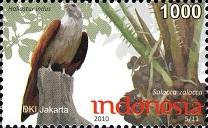
Fig. 26. İndoneziyanın poçt markası (Stamps of Indonesia) Comment "The salak palm in Florida has not produced as anticipated. Fairchild Tropical Garden, with dioecious palms, had them fruiting after 37 years. The writer grew six Bali type salak palms that were finally removed after 25 years without a fruit. Plans are underway to try again, using a shade cloth cover instead of a tree-shaded location." 3 William F. Whitman, Five Decades with Tropical Fruit, 2001 Other Edible palm species: Cabbage Palm - Sabal palmetto Canary Island Date Palm - Phoenix canariensis Coconut Palm - Cocos nuficera Date Palm - Phoenix dactylifera California Fan Palm - Washingtonia filiferas Fan Palm - Phoenix canariensis Pindo Palm - Butia odorata Peach Palm - Bactris gasipaes List of Growers and Vendors |
|||||||
| Bibliography 1 "Salacca zalacca." Ecocrop, Food and Agriculture Organization of the UN, ecocrop.fao.org. Accessed 19 Nov. 2015. 2 "Salacca zalacca." Useful Tropical Plants Database, tropical.theferns.info/viewtropical.php?id=Salacca+zalacca. Accessed 19 Nov. 2015. 3 Whitman, William F. Five Decades with Tropical Fruit, A Personal Journey. Stuart, Quisqualis Books in cooperation with Fairchild Tropical Garden, 2001. 4 worldagroforestry.org. Accessed 19 Nov. 2015. 5 "Salak." Wikipedia, en.wikipedia.org/wiki/Salak. Accessed 19 Nov. 2015. 6 Mogea, Johanis P. "Salacca zalacca var. amboinensis." Wikipedia, Principes 26: 71, 1982, wikipedia.org. Accessed 19 Nov. 2015. 7 McDonnell, Michael. "Salak Palm Fact Sheet." Archives of the Rare Fruit Council of Australia, July. 1990, rfcarchives.org.au. Accessed 20 Nov. 2015. 8 Whitman, William F. "The Salak Palm." Archives of the Rare Fruit Council of Australia, rfcarchives.org.au. Mar. 1980. Accessed 20 Nov. 2015. 9 Marshall, John. "The Salak Palm." Archives of the Rare Fruit Council of Australia, Mar. 1984, rfcarchives.org.au. Accessed 20 Nov. 2015. 10 "Salacca zalacca (Gaertn.) Voss synonyms." The Plant List (2013). Version 1.1., www.theplantlist.org/tpl1.1/record/kew-181818. Accessed 21 May 2019. 11 "Taxon: Salacca zalacca (Gaertn.) Voss. Common names." USDA, Agricultural Research Service, National Plant Germplasm System, 2019, Germplasm Resources Information Network (GRIN-Taxonomy), National Germplasm Resources Laboratory, Beltsville, Maryland, npgsAccessedars-grin.gov/gringlobal/taxonomydetail.aspx?id=401079. Accessed 21 May 2019. 12 Schuiling D.L. and J. P. Mogea. "Salacca zalacca (Gaertner) Voss." Plant Resources of South-East Asia, 6 Feb 2016, (CC BY-SA 3.0), plantuse.plantnet.org/en/Salacca_zalacca_(PROSEA). Accessed 2 Oct. 2026. 13 Fern, Ken. "Salacca zalacca (Gaertn.) Voss." Plants For a Future, pfaf.org/user/Plant.aspx?LatinName=Salacca+zalacca. Accessed 6 Oct. 2026. Photographs Fig. 1 istolethetv. "Ripe fruit, cut open to reveal the flesh." Useful Tropical Plants, (CC BY 2.0), tropical.theferns.info/viewtropical.php?id=Salacca+zalacca. Accessed 18 Nov. 2016. Fig. 2 Crisco 1492. "Salak pondoh cultivar." Wikimedia, 2015, (CC BY-SA 4.0), wikimedia.org. Accessed 18 Nov. 2016. Fig. 3 Tris_T7. "Salak (Salacca zalacca) of Bali, Indonesia." Wikimedia Commons, 1 Jan. 2019, (CC BY-SA 4.0), commons.wikimedia.org/wiki/File:Salacca_Indica_Sala_Indo_6.JPG. Accessed 7 Oct. 2026. Fig. 4,13,16 Kwan. "Salacca zalacca, Salak, Snake Palm." The Plant Observatory, 2008, natureloveyou.sg. Accessed 16 May 2014. Fig. 5 A2613. "Leaf of Salacca zalacca (salak) in Ir. H. Djuanda Forest Park, Bandung." Wikimedia Commons, 24 Jan. 2025, (CC BY-SA 4.0), commons.wikimedia.org/wiki/File:Salacca_zalacca-daun-A2613.jpg. Accessed 7 Oct. 2026. Fig. 6 Culbert, Dick. "Inflorescence." Useful Tropical Plants, (CC BY 2.0), tropical.theferns.info/viewtropical.php?id=Salacca+zalacca. Accessed 18 Nov. 2016. Fig. 7 Swaymedia-Jayson. "Salak, Salk (snakefruit)." Wikimedia, 2005, (CC BY 2.0), wikimedia.org. Accessed 18 Nov. 2016. Fig. 8 Jaitt, Oscar. "Salak, 'Bali'." Fruit Lovers, fruitlovers.com. Accessed 16 May 2014. Fig. 9 "Fruit." USDA, ARS, USDA, ARS, National Genetic Resources Program, Germplasm Resources Information Network (GRIN), National Germplasm Resources Laboratory, Beltsville, Maryland, ars-grin.gov. Accessed 18 Nov. 2016. Fig. 10 Joergens.mi. "Fruit of the salak palm, Salacca zalacca, with cross-sections. Also called snake fruit. This is a collage, as only one fruit was available." Wikimedia Commons, 12 May 2023, (CC BY 3.0), commons.wikimedia.org/wiki/File:Salak_(Salacca_zalacca)_jm161636.jpg. Accessed 28 Sept. 2026. Fig. 11 っ. "Salak (Salacca zalacca) of Bali, Indonesia." Wikimedia Commons, (CC BY-SA 3.0),(GFDL), July 2005, commons.wikimedia.org/wiki/File:Salak200507.jpg. Accessed 7 Oct. 2026. Fig. 12 Tris_T7. "Salak (Salacca zalacca) of Bali, Indonesia." Wikimedia Commons, 1 Jan. 2019, (CC BY-SA 4.0), commons.wikimedia.org/wiki/File:Salacca_Indica_Sala_Indo_16.JPG. Accessed 7 Oct. 2026. Fig. 14 Trindade, Josh. "Salacca zalacca, Viqueque, a city in the south-east of East Timor." Wikimedia Commons, 28 Jan. 2017, (CC BY-SA 4.0), Image cropped, commons.wikimedia.org/wiki/Category:Fruit_of_East_Timor#/media/File:Salak_Fruits_in_Viqueque.JPG. Accessed 7 Oct. 2026. Fig. 15 Xnau. "This is some salak (snake fruit) growing on the tree in Bali." Wikimedia Commons, 2009, (CC BY 3.0), commons.wikimedia.org/wiki/File:Bali_salak_fruit.jpg. Accessed 19 Nov. 2015. Fig. 16 Dransfield, John. "Salacca zalacca, Karangasem, Bali, Indonesia." Royal Botanic Gardens, Kew/Palmweb, (CC BY NC SA 3.0), Image cropped, www.palmweb.org/cdm_dataportal/taxon/616b7e6d-2f79-4139-92ad-87ed028eebc3. Accessed 28 Sept. 2026. Fig. 18 Aleph500Adam. "Salak Seedlings about 1 year old." Wikimedia Commons,7 Aug. 2022, (CC BY-SA 4.0), Image cropped, commons.wikimedia.org/wiki/File:Salak_Bali_Gula_Pasir.jpg. Accessed 28 Sept. 2026. Fig. 19 Cliff. "Cultivated plant in Hawai‘i Tropical Botanical Garden, Big Island." Useful Tropical Plants, (CC BY 2.0), tropical.theferns.info/viewtropical.php?id=Salacca+zalacca. Accessed 18 Nov. 2016. Fig. 20 Cliff. "Plant growing in native habitat." Useful Tropical Plants, (CC BY 2.0), tropical.theferns.info/viewtropical.php?id=Salacca+zalacca. Accessed 18 Nov. 2016. Fig. 21,22 Jackson, Karen. "Salak 'Bali'." Growables, 2013. Fig. 23 Culbert, Dick. "Fruits for sale in the market." Useful Tropical Plants, tropical.theferns.info/image.php?id=Salacca+zalacca. Accessed 18 Nov. 2016. Fig. 24 Midori. "Bahasa Indonesia: Penjual salak Pondoh, Jalan Malioboro." Wikimedia, 2011, (CC BY 3.0), wikimedia.org. Accessed 18 Nov. 2015. Fig. 17 Lawson, Boy. "Women selling salak and krupuk at the market." 1925-1992, Wereldmuseum Amsterdam, via Wikimedia Commons, 1971, (CC BY 3.0), commons.wikimedia.org/. Accessed 18 Nov. 2015. Fig. 18 User Cekli829. "Stamps of Indonesia." 2010, Post of Indonesia, Wikimedia Commons, Public Domain, commons.wikimedia.org/wiki/File:Stamps_of_Indonesia,_037-10.jpg. Accessed 18 Nov. 2015. * UF/IFAS Assessment of Non-native Plants in Florida's Natural Areas Published 16 May 2014 LR. Last update 7 Oct. 2026 LR |
||||||||